
Quick Summary
This commercial gate access control systems guide explains how facility managers can protect perimeter entry points by integrating digital credential readers, control boards, and electromechanical operators to eliminate costly operational delays. Experts at Total Gate Repair Care emphasize that long-term system reliability requires pairing the right credential technology-such as RFID, keypads, or cellular controllers-with weatherproofed hardware and solid physical infrastructure. After reading, facility owners will be able to assess site-specific installation demands, implement essential mechanical maintenance, and contact Total Gate Repair Care for professional consultation on system upgrades and repairs.
Commercial Gate Access Control Systems Guide: Fast Setup
This commercial gate access control systems guide breaks down how secure perimeter entry points are engineered, installed, and maintained. Real-world commercial gate pricing varies depending on site conditions, groundwork, and physical equipment requirements. Broad facility access control cost estimates are not gate-specific, and specific installation price ranges represent external estimates not substantiated by this research brief. When a primary security gate fails during a morning shift change or halts a delivery fleet, operational delays hit the bottom line immediately.
According to industry data from MarketsandMarkets, the broader U.S. access control market was estimated at $2,374.7 million in 2025, with the commercial segment accounting for an estimated $941.1 million. While software and cloud platforms grab headlines, keeping an industrial perimeter secure comes down to mechanical reliability under tough outdoor conditions. Whether you manage a logistics yard, a self-storage facility, or a business park, this guide covers access technologies and practical installation considerations.[1]
How Commercial Gate Access Control Systems Work to Secure Facilities
How Commercial Gate Access Control Systems Work to Secure Facilities in brief: Commercial gate access control systems connect an outdoor credential reader (a keypad, card reader, RFID antenna, or mobile receiver) to a central control board and an electromechanical gate operator. Once the user presents valid credentials, the controller trips a low-voltage relay that signals the motor to cycle open while photo eyes and safety loops protect passing vehicles.[5]
Understanding commercial gate security requires looking past the digital software to the physical machinery operating outdoors. Findings from a survey involving almost 500 security, facilities management, and IT professionals in April and May 2025 revealed that wireless systems, fully or partly, had overtaken wired-only deployments among respondents managing access digitally. On properties running business park gate automation, daily operation relies on the physical link between the access controller and the operator motor pulling the gate leaf.[2]
The Core Architecture: Readers, Controllers, and Electromechanical Operators
Commercial automatic gate entry systems operate across three primary layers:
- Front-End Readers: Keypads, RFID readers, telephone entry panels, or wireless receivers placed at driver height on an approach pedestal.
- The Control Board: The logic processor that stores access privileges, monitors safety inputs, and manages relay timing.
- The Industrial Operator: The physical motor, gearbox, drive chain, or hydraulic mechanism that moves the gate structure.
As technicians at Total Gate Repair Care emphasize, physical components such as hinges, wiring, and aligned safety sensors work alongside control software to keep gate systems operational.
Data Verification Flow from Credential Scan to Gate Actuation
Industrial gate access solutions process entry commands through a sequence:
- Credential Presentation: A user enters a PIN, presents an RFID card or fob near a reader, or uses a mobile credential on a phone.
- Permission Verification: The reader sends credential data to the control board to verify access schedules and user authorization.
- Relay Trigger: Once verified, the controller energizes an output relay wired to the gate operator’s open command terminal.
- Monitored Movement: The motor moves the gate open while safety sensors monitor the drive lane to prevent the barrier from closing on a vehicle.
Comparing Key Commercial Gate Access Technologies
Need commercial gate access control systems guide?
We’re available now — call for a fast, free estimate.
Commercial credential technologies balance convenience, hardware configuration, and administrative upkeep. Basic numeric keypads suit low-turnover facilities, while cellular units and RFID readers accommodate higher vehicle traffic.
| System Type | Credential Mechanism | Trenching & Cabling | User Management |
|---|---|---|---|
| Digital Keypads | PIN code entry | Direct low-voltage line to motor | Manual updates at the pedestal |
| RFID Readers | Card or fob presented near reader | Loop wiring and reader conduit | Physical badge or tag assignment |
| Mobile / Cellular Controllers | Phone (NFC or Bluetooth Low Energy) | Minimal cabling (cellular/wireless connection) | Remote management via web browser |
| Telephone Intercoms | Direct visitor communication | Direct data line or wireless connection | Directory synchronization |
Keypads and Digital PIN Access
Keypads provide PIN entry where users input an authorized numeric code. PIN updates are periodically required to maintain access security across user groups.
RFID Entry Systems
RFID systems operate by having authorized users present a card or fob near an RFID reader, signaling the gate controller to cycle the entry open.
Cellular and Mobile Entry Systems
Mobile access control systems use a phone, commonly communicating via NFC or Bluetooth Low Energy, to authenticate credentials. Wireless and cellular connections reduce physical data trenching requirements across facilities.[3]
Telephone Entry and Video Intercoms
Multi-tenant commercial facilities use telephone and video entry panels to route incoming visitors to specific offices. Proper enclosure sealing and wiring isolation protect internal components from moisture and interference.
Commercial Gate Access Control Installation and Budget Factors
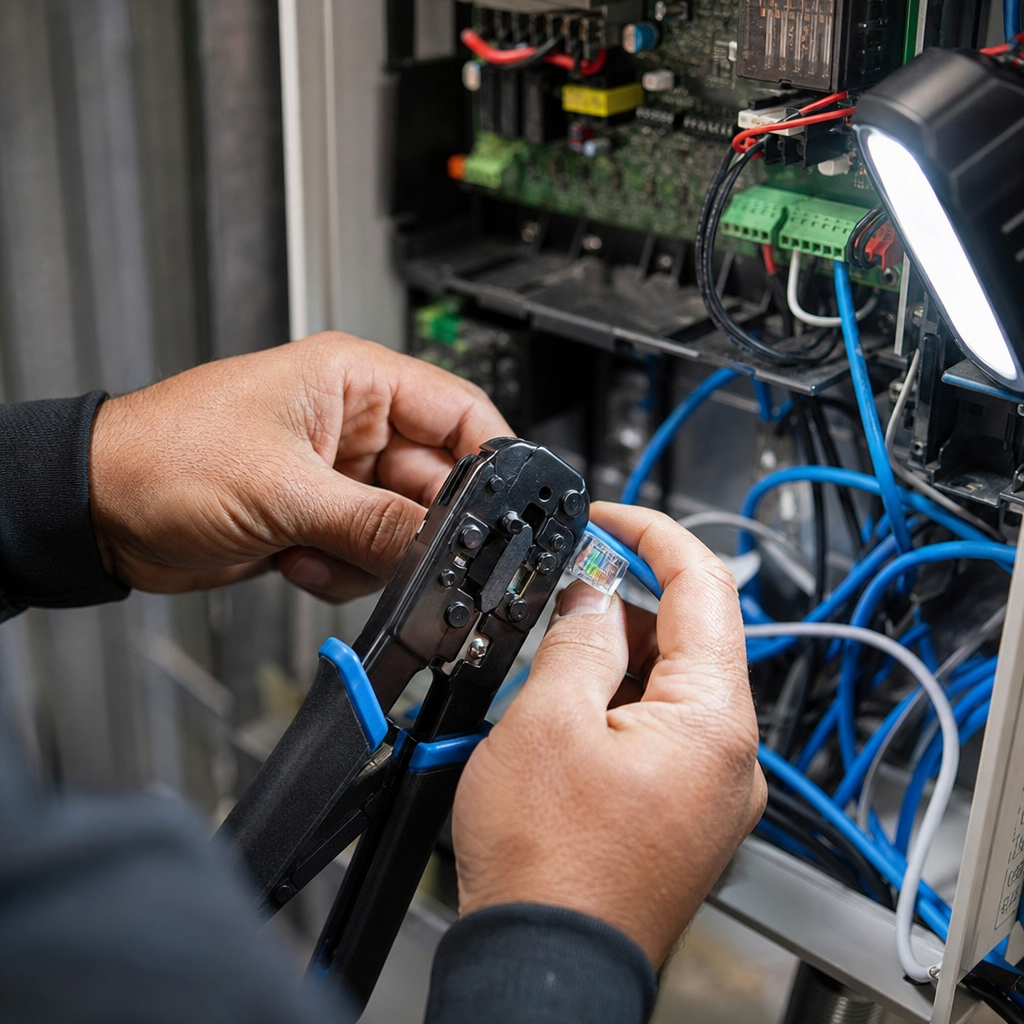
Commercial gate installation costs vary widely depending on gate dimensions, operator type, power availability, and ground conditions. Broad access control price estimates apply across general facilities and are not gate-specific; precise costs depend on site requirements.
Site Factors Influencing Installation Costs
Physical job site demands create major cost variations:
- Pavement Cutting and Trenching: Installing safety loops and running conduit beneath existing asphalt or concrete requires saw-cutting, trenching, and surface repair.
- Electrical Power Runs: Supplying dedicated electrical service across extended distances to a perimeter entry can significantly impact total project costs.
- Pedestal and Post Footings: Commercial gates require solid concrete footings to support heavy posts and resist ground movement.
Electromechanical and Environmental Considerations
Need commercial gate access control systems guide?
We’re available now — call for a fast, free estimate.
Gate operations depend on both digital access controls and the physical condition of mechanical hardware operating in outdoor environments.
Ground Shifts and Post Alignment
In areas subject to ground movement or heavy rain, soil shifting around structural posts can pull posts out of alignment. Misalignment can strain mechanical hinges, misalign optical safety sensors, and prevent magnetic locks from engaging cleanly.
Corrosion, Moisture Intrusion, and Electrical Protection
Outdoor enclosures and access pedestals are subject to weather extremes and humidity. Condensation can corrode terminal blocks, damage communication wiring, and affect sensitive circuit boards. While 58% reported their organizations had deployed biometrics to some extent, specialists at Total Gate Repair Care note that all outdoor credential hardware requires adequate weatherproofing and proper grounding.[4]
Recommended mechanical maintenance practices include:
- Hinge and Track Alignment: Check posts, lubricate bearings, and ensure the gate leaf moves without excessive resistance.
- Operator Inspection: Verify the gate motor operates smoothly within manufacturer guidelines.
- Enclosure Sealing: Check weather seals, clear enclosure drain holes, and protect electrical terminations against moisture.
Choosing a Commercial Gate Contractor
Securing a commercial entrance requires experienced installation personnel familiar with access electronics and gate hardware. Key considerations include:
- Comprehensive Experience: Selecting technicians capable of servicing mechanical components, operators, and electronic access controls.
- Service Availability: Ensuring prompt support and access to standard manufacturer replacement parts.
- Thorough Inspection: Choosing contractors who evaluate gate balance, safety devices, and electrical connections before recommending component replacements.
Frequently Asked Questions
How do commercial gate access control systems work?
An entry reader captures user credentials, sends that data to a local or cloud controller to confirm permissions, and triggers a low-voltage relay. This relay activates the gate operator motor to open the physical gate while safety sensors keep the pathway clear.
What is the difference between RFID, keypad, and mobile gate entry systems?
PIN entry uses an entered code on a keypad, RFID uses a card or fob presented near a reader, and mobile credentials use a phone, commonly communicating via NFC or Bluetooth Low Energy.
Can you automate an existing manual commercial gate?
Yes, provided the gate structure, hinges, and posts are in suitable mechanical condition. A technician reinforces the frame, mounts an operator, installs safety sensors, and connects the credential readers.
What happens to commercial gate systems during a power outage?
Gate systems may be configured with battery backup units or manual release mechanisms to allow gate operation or manual access when primary power is interrupted.
How often should commercial access control gates be serviced?
According to maintenance guidelines from Total Gate Repair Care, commercial gates should be inspected and serviced periodically according to manufacturer guidelines, site usage levels, and environmental exposure.
How do wireless and cellular entry systems connect?
Cellular and wireless controllers connect over mobile or wireless data networks, providing an alternative to hardwired communication lines for access management and configuration.
Need commercial gate access control systems guide?
We’re available now — call for a fast, free estimate.
Sources
- US Access Control Market (2025-2030) : Size and Share – marketsandmarkets.com (2030)
- [PDF] Is it time to invest in mobile access? – Assa Abloy – assaabloy.com (2031)
- [PDF] Wireless Access Control Report 2025 – Assa Abloy – assaabloy.com (2025)
- www.abloy.com · gb · enWAC report 2025 | ABLOY for Trust – abloy.com (2025)
- WAC report 2025 | ASSA ABLOY – assaabloy.com (2025)
Related reading: Residential Access Control – Call Now-10% Off – Same-Day Service – Free Estimate
Related reading: Gate Hinge Welding Repair Vs Replacement | Call Now-10% Off | On-Site in 60 Minutes | Free Estimate
Related reading: Home Security Camera Installation Companies – 10% Off & Free Estimate – Same-Day Service
Frequently Asked Questions
How do emergency vehicles and first responders gain access through an automated commercial gate?
Commercial installations typically incorporate specialized emergency access hardware, such as Knox key switches, optical strobe sensors, or acoustic siren detectors. Certified technicians at Total Gate Repair Care wire these override devices directly into the gate controller to ensure code compliance and rapid access during emergencies.
Can a commercial gate access control system integrate with existing building security software?
Yes, most modern gate control boards support standard protocols such as Wiegand and OSDP, allowing them to integrate with existing building access databases and badge systems. Total Gate Repair Care evaluates interface compatibility to synchronize your perimeter gate credentials with your central management platform.
When is a cellular gate access controller preferable to running hardwired data lines?
Cellular access controllers are ideal for sites where cutting asphalt or trenching conduits over long distances would be cost-prohibitive. Total Gate Repair Care often recommends cellular units for logistics yards and business parks that need fast deployment, reliable wireless connectivity, and remote administrative access.
About the author
 |
Marcus Vance Marcus Vance is a seasoned security systems specialist with over 12 years of experience in the access control industry. Holding a degree in Electrical Engineering from California State Polytechnic University, Pomona, he focuses on the practical application of gate motor diagnostics and commercial access solutions. His writing aims to provide actionable maintenance advice for property owners and facility managers. |