
Quick Summary
Choosing between gate hinge welding repair vs replacement requires evaluating the underlying metal condition and pivot alignment to prevent opener motor strain and recurring structural failure. Total Gate Repair Care emphasizes that while clean weld separations on sound steel can be resolved with on-site precision re-welding, bent, severely rusted, or internally worn hinges require full weld-on replacement. Property owners will understand key warning signs of hinge failure and can contact Total Gate Repair Care to schedule a professional on-site diagnostic inspection and upfront estimate.
Gate Hinge Welding Repair vs Replacement: Fix It Fast & Safely
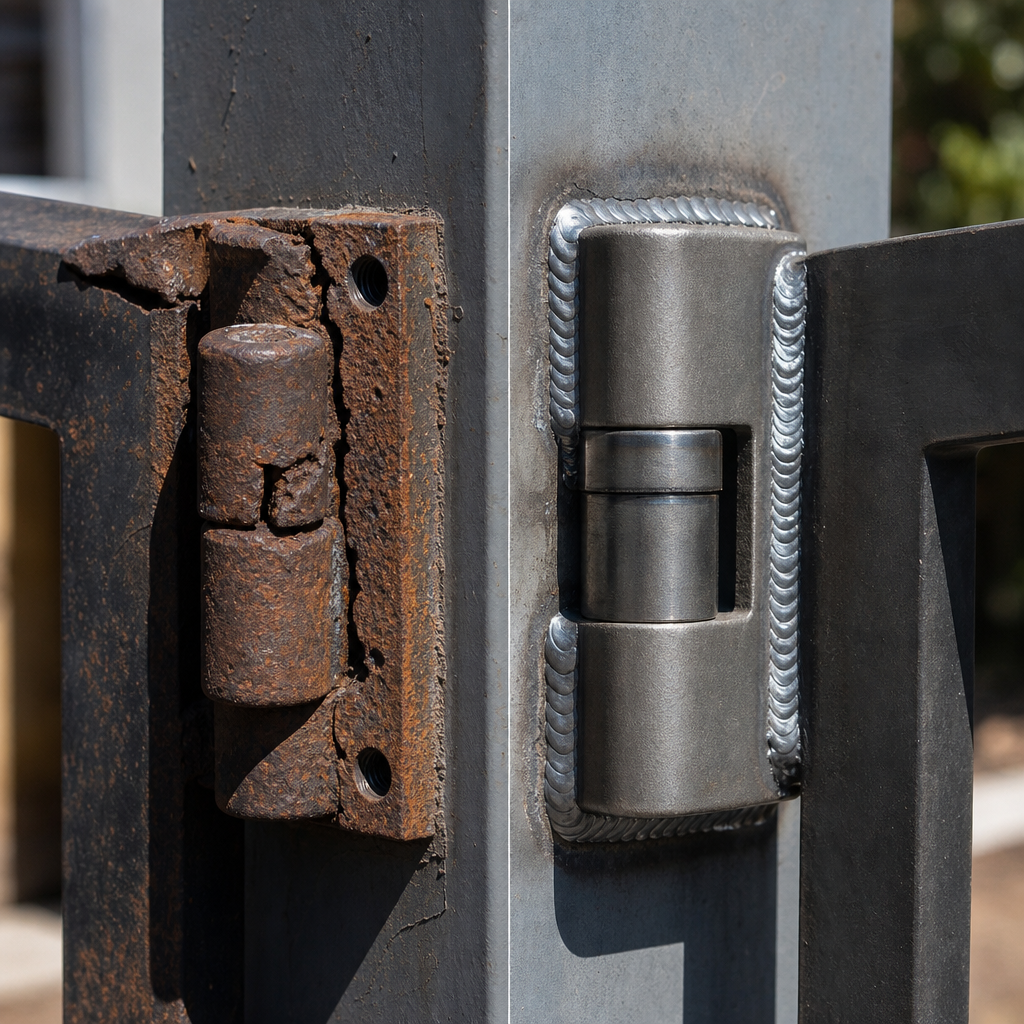
When an automated driveway gate begins to drag, stick, or pull away from its post, choosing between gate hinge welding repair vs replacement comes down to evaluating base metal condition and hinge integrity. Re-welding a detached hinge bracket may be appropriate when damage is isolated to an old weld bead on sound steel. If the hinge is cracked, rusted, bent, or structurally weakened, replacement is usually safer.[2]
Note: Neutral, authoritative gate-specific statistics and pricing were not available in the retrieved research.[3]
For property owners and facility managers, an accurate assessment helps avoid repeated service calls and protects gate systems from unnecessary strain. Understanding how a professional welder at Total Gate Repair Care evaluates hinge condition helps you choose the appropriate repair method.
Gate Hinge Welding Repair vs Replacement: Quick Comparison
Repair can be appropriate for isolated damage on sound metal, while replacement is safer for cracked, rusted, bent, or structurally weakened hinges.
| Service Option | Best Application |
|---|---|
| Precision Re-Welding | Isolated weld separations where the hinge body, pin, and gate post metal are undamaged. |
| Weld-On Hinge Replacement | Cracked, heavily rusted, bent, or structurally weakened hinges. |
Before ordering mobile welding services, a clear inspection of the hinge determines whether re-attaching the existing bracket may be appropriate or if full replacement is safer.
Is It Better to Weld or Replace a Broken Gate Hinge?
Deciding whether to weld or replace hinges on heavy iron or steel gates requires looking closely at mechanical alignment and hardware condition, not just the separated joint.[1]
When On-Site Hinge Re-Welding May Be Appropriate
Re-welding may be appropriate when an otherwise sound weld failed due to sudden impact, poor initial penetration, or localized vibration, provided the base steel has not torn. A mobile welding technician typically can:
- Support the gate panel with jacks or rigging to relieve mechanical load.
- Grind away oxidized metal, slag, and paint until clean parent metal is exposed.
- Check the vertical plumb of the post and the gate leaf.
- Apply a full-penetration structural weld and seal the joint against rust.
When Complete Hinge Replacement Is Usually Safer
Welding cannot restore severely worn or degraded hardware. Hinge replacement is usually safer when:
- Pivot components are worn or misaligned: Internal pivot wear or distortion can cause gate sag that re-welding cannot eliminate.
- The base metal has torn away: When a hinge pulls out a section of the post wall, the post may require structural reinforcement before a new hinge can be welded in place.
- Internal hinge components have failed: Hinges with seized or degraded internal components generally cannot be restored through surface welding.
Risks of Welding Over Compromised Hardware
Attempting to re-weld severely worn or distorted hinge hardware without addressing structural wear can introduce irregular pivot angles. This may subject the new weld to uneven twisting forces, increasing the risk of premature cracking and placing excess load on automated gate operators.
Evaluating Scope: Gate Hinge Welding Repair vs Complete Replacement
Need gate hinge welding repair vs replacement?
We’re available now — call for a fast, free estimate.
According to Total Gate Repair Care, while on-site welding carries lower initial material requirements, replacing compromised hardware is usually safer over the long term by helping protect automated operators from excessive strain.
| Repair Scope | Primary Application | Durability Expectation |
|---|---|---|
| Standard Surface Re-Weld | Clean separation on sound metal | Effective when base metal and hinge are intact |
| Reinforced Gusset & Bracket Weld | Heavy gates needing extra post support | Provides additional reinforcement on sound structures |
| Hinge Replacement | Cracked, bent, rusted, or structurally weakened hinges | Provides a fully restored pivot assembly |
Hinge Welding Repair Overview
Re-welding a detached hinge involves surface preparation with an angle grinder, welding consumable application, and protective zinc-rich primer with matched topcoat paint. If the base metal is solid, this can be an effective, localized repair.
New Weld-On Hinge Replacement Overview
Replacing a welded barrel or heavy-duty hinge involves cutting off damaged hardware, grinding the post and gate frame flush, measuring swing geometry, welding new hardware into place, and verifying smooth leaf movement.
Protecting Gate Operators
A sagging or binding gate forces the gate opener to work against elevated resistance. Investing in proper hinge replacement when hardware is compromised helps protect drive motors from strain and reduces the likelihood of operational failure.
Signs Your Gate Hinge Needs Immediate Professional Intervention
Catching hinge failure early helps avoid emergency situations where a gate drops or disrupts access. Watch for these mechanical red flags:
Visual Warning Signs
- Flaking rust along weld seams: Powdered rust or peeling paint around a weld joint can indicate stress fracturing underneath.
- Gaps between leaves that do not line up: On dual-swing gates, if the center latch or magnetic lock no longer meets squarely, hinge deflection may be occurring.
- Post deflection: The mounting post may show signs of bending or twisting under the weight of an open gate leaf.
Operational Red Flags
- Scraping the driveway: The lower outer corner of the gate touches the ground during its swing.
- Opener groaning or stuttering: The electric motor hesitates, chatters, or triggers obstacle-reversal limits midway through its travel.
- Squealing or metal shavings: Metal dust collecting below the hinge barrel indicates internal friction and wear.
How Professional Mobile Welding Restores Heavy-Duty Driveway Gates
Proper repair of heavy steel and wrought iron gates requires dedicated mobile equipment to ensure structural strength and fire safety on-site.
- Load Relief and Safety Rigging: Technicians support the gate panel using lever jacks and stabilizing clamps to relieve load during hardware servicing.
- Joint Preparation: Fatigued metal, old weld slag, and surface coatings are ground down to bare parent steel to ensure proper weld fusion.
- Tolerancing and Pin Alignment: Technicians check vertical alignment to help ensure upper and lower hinges distribute the gate load appropriately.
- Structural Welding Passes: Multi-pass welds join the hinge leaves to the post and gate frame to handle dynamic swing loads.
- Corrosion Barrier Application: Welds are cleaned, treated with cold-galvanizing zinc primer, and coated with weather-resistant paint to help block moisture.
- Operator Arm Re-Alignment: Technicians check swing opener brackets and limit settings to facilitate smooth travel through the full cycle.
Frequently Asked Questions About Gate Hinge Repair and Replacement
How long does a welded gate hinge repair last?
As noted by Total Gate Repair Care, a full-penetration weld completed on sound steel can provide long-term service, provided the pivot hardware is in good condition and regularly maintained.
Can a rusted iron gate hinge be safely re-welded?
Light surface rust can be ground away before welding. However, if rust has caused deep pitting, laminated flaking, or structural metal loss on the hinge or post, replacement is usually safer.
Why did my hinge weld break in the first place?
Weld breaks may occur due to insufficient initial weld penetration, high wind loads, physical impacts, or mechanical wear that creates twisting forces on the joint.
What qualifications should a mobile gate welder have?
Look for mobile technicians experienced in structural steel welding, gate geometry, and automated access control systems. They should carry proper business licensing, general liability insurance, and appropriate equipment to handle repairs safely.
Need gate hinge welding repair vs replacement?
We’re available now — call for a fast, free estimate.
Sources
- Legal matters – Buildings Department – bd.gov.hk (2025)
- I – epa.gov
- The Essential Guide to – ils.unc.edu
Related reading: Residential Access Control – Call Now-10% Off – Same-Day Service – Free Estimate
Related reading: Home Security Camera Installation Companies – 10% Off & Free Estimate – Same-Day Service
Related reading: Best Commercial Gate Repair Services Santa Paula | Call Now-10% Off | On-Site in 60 Minutes | Free Estimate
Frequently Asked Questions
Should I disconnect my automated gate opener if a hinge weld is cracked or sagging?
Yes, you should immediately switch your automated operator to manual mode or disconnect the operator arm to prevent motor burnout and gear damage. Operating a misaligned or sagging gate forces the drive motor to push against severe friction and irregular resistance. Total Gate Repair Care recommends leaving the gate stationary until a technician can assess whether re-welding or complete hinge replacement is needed.
How long does on-site gate hinge welding repair or replacement typically take?
Most standard on-site re-welding repairs take between one and two hours to complete, whereas a full weld-on hinge replacement usually takes two to four hours. The timeframe accounts for safety rigging, surface grinding down to bare parent metal, multi-pass welding, and the application of weather-resistant primer.
How can I prevent a newly welded gate hinge from failing again?
Lubricate internal pivot pins or grease zerk fittings with high-grade synthetic grease every six months to reduce rotational drag. Additionally, inspect the weld seams twice a year for paint flaking or surface rust, and contact Total Gate Repair Care if you detect any gate sag or latch misalignment.
About the author
 |
Sarah Miller Sarah Miller is a security and access control specialist with over eight years of experience in the automated gate industry. Holding a degree in Mechanical Engineering Technology from California State Polytechnic University, Pomona, she combines technical knowledge with practical insights. Her writing focuses on residential and commercial gate systems, specializing in emergency repair protocols and preventive maintenance. |