
Quick Summary
Learning how to maintain sliding gate tracks is essential for preventing sticking, roller failure, and hazardous gate derailments caused by accumulated debris or shifted ground footings. Total Gate Repair Care outlines a proactive maintenance routine focused on sweeping the travel line, applying manufacturer-specified lubrication, and inspecting positive stops to prevent motor burnout and ensure safety. Readers will understand how to properly clean and inspect their gate hardware while recognizing when to schedule a professional track realignment for structural warping or mechanical failures.
How to Maintain Sliding Gate Tracks: Prevent Sticking Fast
When a sliding driveway gate starts sticking, shuddering, or grinding against its track, the root cause is often friction from trapped grit, unseated rollers, or misaligned hardware. From 2014 through 2024, 13 of 16 serious injury or fatal gate incidents in California workplaces involved failed or missing end stops or positive stops. A gate that jumps the track can fall and should be taken out of service for qualified inspection and repair.[3]
Automated gates should be turned off and secured before maintenance. Keeping your gate moving freely requires a consistent upkeep routine, as recommended by specialists like Total Gate Repair Care: clearing dirt out of the track profile, checking roller wear, testing travel stops, and following proper lubrication guidance. Gate-hardware repairs should be handled by qualified persons.
Sliding Gate Track Maintenance: Overview and Essential Tools
A ground track takes the brunt of vehicle traffic, standing water, and blowing soil. Over time, concrete settlement and everyday debris can affect gate alignment. Having the right tools on hand makes inspections effective.
What you will need for gate track care
- Stiff-bristle brush: Scrapes dried mud and compacted gravel out of the track.
- Shop vacuum or leaf blower: Clears loose dust and grit from track areas.
- Garden hose: Rinses away fine sediment.
- Socket set and open-end wrenches: Tightens anchors and guide roller brackets.
- Masonry string line and level: Identifies dips and bowed rails.
- Manufacturer-specified lubricant: Used strictly when specified by the manufacturer.
- Heavy work gloves: Protects hands from metal burrs, sharp edges, and pinch points.
Step 1: Clear Dirt, Rocks, and Compacted Silt from the Track Channel
The ground rail is exposed to environmental debris. Leaves, pebbles, and silt settle into the track channel, interfering with smooth roller travel across the rail.
Removing loose gravel and organic debris
- Sweep the full travel line: Clear the entire path of travel, from the fully closed position back into the open run-out zone.
- Clean out the catch pockets: Clear dirt and gravel from guide receivers, safety catchers, and the areas surrounding travel stops.
Scraping hardened mud and packed sediment
In areas subject to runoff or seasonal dust, dirt can pack alongside the rail crown. Use a scraper to dislodge caked mud from both sides of the track, ensuring the roller flanges have clean clearance.
Step 2: Wash the Metal Track and Clean Roller Contact Surfaces
Once large debris is gone, fine abrasive silt may remain on the metal surfaces.
Rinsing away grit
Wash the metal rail using a garden hose to rinse away remaining sediment from the travel surface.
Drying and inspecting the track
Wipe down the rail with a dry cloth or allow it to air-dry completely. Once dry, inspect the finish and track condition for signs of physical damage or excessive wear.
Step 3: Lubrication Guidance for Sliding Gate Tracks
Use only lubricant specified by the gate or wheel manufacturer. Avoid applying lubricant directly to the track unless the manufacturer recommends it, because residue can attract dirt and grit.
Proper lubrication points
Always consult manufacturer instructions before applying lubricants to any gate components:
- Wheel bearings: Apply lubricant only if recommended by the manufacturer and use the specific type designated in the maintenance manual.
- Guide rollers: Apply lubricant to roller shafts only when specified by the manufacturer. Wipe away any excess lubricant so it cannot drip onto the track below.
Step 4: Inspect Rollers, Bearings, and Safety End-Stops for Wear
Need how to maintain sliding gate tracks?
We’re available now – call for a fast, free estimate.
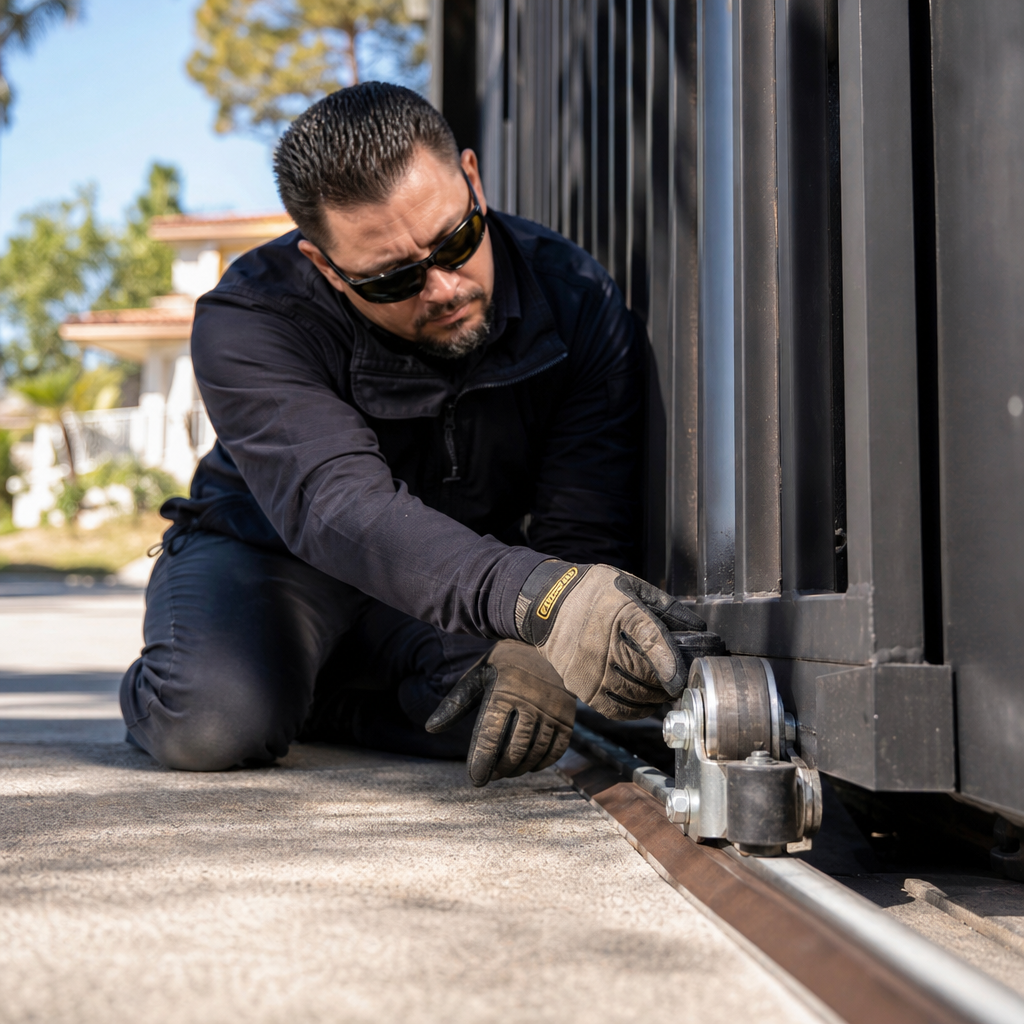
Safety authorities emphasize that mechanical safety hardware requires regular verification. According to materials from the U.S. Consumer Product Safety Commission (CPSC), guide rollers and positive end-stops must work together to keep a sliding gate on its track and prevent it from tipping over. In the UK, the Health and Safety Executive (HSE) similarly states that routine maintenance and the timing of safety checks should be addressed in user instructions to keep powered gates operating safely.[5]
A gate that jumps the track can fall and should be taken out of service for qualified inspection and repair.
Checking wheels for mechanical wear
Carefully observe the gate and check for the following defects:
- Flat spots on wheel rims: Caused by wheels seizing and dragging along the track.
- Bearing play: Lateral wobble or rough sounds when the wheel rotates.
- Damaged wheel flanges: Missing metal or cracks along the wheel guide edge.
Inspecting positive stops and guide brackets
California regulations require every horizontal sliding gate to have positive stops or equivalent devices that limit travel to the designed fully open and closed positions. These stops must be installed and maintained by a qualified person and must be sturdy enough to resist impact loads. Check that positive stops at both ends of the rail are firm, undamaged, and securely anchored.[1]
Step 5: Check Track Alignment and Anchor Fasteners
Moisture changes and ground movement can cause concrete slabs and gate footings to settle unevenly. If the footing shifts, the track may bend and pinch gate rollers.
Detecting track alignment issues
- String-line check: Stretch a tight line directly above the crown of the rail from one end to the other to check for sideways bowing or dips.
- Level check: Place a level along the travel span to identify high spots or uneven sections.
Inspecting track anchors
Inspect fasteners securing the track to the ground. Gate-hardware repairs and structural re-anchoring must be handled by qualified persons, such as the technicians at Total Gate Repair Care.
Step 6: Test Manual Gate Operation
Before testing, ensure automated gates are turned off and secured. A properly installed sliding gate should roll smoothly during manual movement.[4]
Performing the manual movement test
- Disconnect the automatic operator according to the manufacturer’s instructions.
- Move the gate slowly through its entire travel path from fully open to fully closed.
- Feel for areas where resistance increases or rollers bind.
Qualified Repairs and Safety Requirements
Routine cleaning is part of regular maintenance, but gate-hardware repairs should be handled by qualified persons. Automated gates should be turned off and secured before maintenance.
California regulations require positive stops or equivalent devices to limit travel to designed fully open and closed positions, require stops to resist impact loads, and require positive stops and hardware to be installed, maintained, and repaired by qualified persons. In addition, employees who operate or inspect horizontal sliding gates must receive proper instruction in safe operation.[2]
A gate that jumps the track can fall and should be taken out of service for qualified inspection and repair. Contact a qualified person or professional team like Total Gate Repair Care if you observe damaged structural components, unseated rollers, loose positive stops, or misaligned guide rollers.
Frequently Asked Questions About Sliding Gate Track Maintenance
What is the best lubricant for sliding gate tracks?
Use only lubricant specified by the gate or wheel manufacturer. Avoid applying lubricant directly to the track unless the manufacturer recommends it, because residue can attract dirt and grit.
How often should sliding gate tracks be cleaned and inspected?
Inspect and clean the track regularly, increase frequency during heavy use or adverse conditions, and follow the manufacturer’s maintenance schedule.
Why is my sliding gate sticking or jumping off the track?
Gates can stick or derail due to debris in the track channel, worn bearings, shifted track alignment, or loose guide rollers. A gate that jumps the track can fall and should be taken out of service for qualified inspection and repair.
Can WD-40 be used on sliding gate tracks and rollers?
Avoid applying lubricants or sprays to tracks or components unless recommended by the manufacturer. Use only lubricant specified by the gate or wheel manufacturer, as residue can attract dirt and grit.
Need how to maintain sliding gate tracks?
We’re available now – call for a fast, free estimate.
Sources
- Post Discussion Draft – January 2026 (OSHSB) – dir.ca.gov (2026)
- [PDF] Horizontal Sliding and Swinging Gates – dir.ca.gov (2026)
- Petition File No. 605 Cal/OSHA Evaluation – dir.ca.gov (2024)
- Council faces trial following automated gate accident – gate-safe.org (2015)
- Over 90% of commercial gates deemed unsafe – Gate Safe – gate-safe.org
Related reading: Home Door Access Control Systems | Call Now-10% Off | Same-Day Service | Free Estimate
Related reading: Door Access Control System for Home – Call Now-10% Off – Same-Day Service – Free Estimate
Related reading: Residential Automatic Bollards | Call Now-10% Off | Same-Day Service | Free Estimate
Frequently Asked Questions
What should you do if a sliding gate track is warped or sinking due to ground shifting?
If string-line and level checks reveal dips or sideways bowing from ground settlement, avoid forcing the gate to run as this accelerates roller wear and motor strain. Structural track warping and foundation anchor failures require professional leveling and re-securing. You can contact Total Gate Repair Care to schedule a comprehensive track realignment and hardware inspection.
How can you tell if a dirty or misaligned track is straining the gate motor?
Track friction typically manifests as the gate shuddering, moving sluggishly, or stopping unexpectedly during open and close cycles. Disconnect the automatic operator and manually push the gate along the entire travel path to feel for resistance or binding spots. If clearing debris does not restore effortless manual gliding, the track or rollers require mechanical adjustment to prevent motor burnout.
Why are damaged positive end-stops considered a critical safety hazard?
Broken, missing, or loosely anchored positive stops allow sliding gates to travel past safe limits, which can derail the panel and cause catastrophic tip-overs. Safety regulations require heavy-duty end stops capable of resisting impact loads to be maintained by qualified personnel. Total Gate Repair Care can inspect your travel limits and replace compromised stops to keep your gate securely on its rail.
About the author
 |
Sarah Miller Sarah Miller is a security and access control specialist with over eight years of experience in the automated gate industry. Holding a degree in Mechanical Engineering Technology from California State Polytechnic University, Pomona, she combines technical knowledge with practical insights. Her writing focuses on residential and commercial gate systems, specializing in emergency repair protocols and preventive maintenance. |