
Quick Summary
Routine lubrication of automatic gate hinges is essential for preventing motor strain and extending the lifespan of automated swing gates. Total Gate Repair Care recommends cutting operator power, removing surface debris, and applying heavy-duty marine grease through Zerk fittings or white lithium spray into sealed seams rather than using standard penetrating oil. Readers will learn the step-by-step DIY maintenance process and understand when persistent squeaks, sagging frames, or cracked welds require scheduling a professional repair inspection.
How to Lubricate Automatic Gate Hinges – Practical Steps
General maintenance for automatic gate hinges typically involves three practical steps: cutting power to the opener, wiping away surface grit, and applying a suitable grease directly into the pivot core. A frequent DIY mistake is spraying thin aerosol oil across the outside of the hinge, which can create a surface film that collects airborne dirt without adequately lubricating internal contact surfaces. Keeping lubricants away from the operator arm, internal wiring, and safety sensors also helps keep components clean and avoids unwanted mechanical drag.[3]
While an inexperienced handyman might spray basic penetrating oil over dirty hardware and miss a hairline weld crack, Total Gate Repair Care approaches gate hardware with dedicated access control experience. We handle hinge rebuilding, frame realignment to relieve motor strain, and on-site mobile welding throughout Santa Paula and nearby areas. All work begins with clear, upfront estimates. Follow the practical suggestions below to care for your hinges, or reach out to us if your gate remains stiff, noisy, or out of alignment.
Automatic Gate Hinge Maintenance: Fast Overview
Quick Summary: To lubricate automatic driveway gate hinges, turn off breaker power to the opener, clean off accumulated grime, and apply grease into the Zerk fittings using a standard grease gun. For sealed barrel hinges without fittings, apply a silicone or white lithium lubricant into the pivot seams. Avoid relying on standard WD-40 for ongoing lubrication, and keep in mind that maintenance intervals vary by gate model, environment, and manufacturer guidance.[1]
Applying an appropriate lubricant helps reduce friction that can otherwise place extra strain on an electric gate motor. Heavy automatic swing gates generally benefit from grease applied directly to pivot pins rather than light surface sprays that can attract dust from nearby roads, orchards, and open fields.
Key Takeaways for Property Owners
- Safety First: Turn off breaker power and disengage or detach the drive arm before working near the gate leaf.
- Lubricant Options: Heavy-duty marine or synthetic lithium greases are commonly used for Zerk fittings, while silicone or white lithium sprays are typical for non-greasable seams. Always consult manufacturer documentation for specific lubricant specifications.
- Wear vs. Friction: If lubrication does not resolve stiffness, squeaking, or dragging, the internal components or mounting welds may require mechanical inspection rather than more grease.
What You Need: Practical Lubricant Considerations
Selecting a lubricant for electric gate hinges involves finding products intended for outdoor mechanical loads rather than light household oils. For many automated swing gates, an NLGI No. 2 marine grease or synthetic lithium complex provides good resistance to outdoor moisture and dust, though property owners should always verify recommendations in their manufacturer manual.
Common Lubricants and General Uses
Marine-grade grease is commonly used to provide moisture resistance and mechanical stability for outdoor pivot pins. Standard WD-40 is generally avoided for long-term lubrication because its solvent base thins existing grease and can leave a residue that collects grit. Water-resistant synthetic greases are often preferred for heavy applications to help minimize contamination.[2]
| Feature | Heavy-Duty Marine Grease | White Lithium Spray | Standard Penetrating Oil |
|---|---|---|---|
| Primary Action | Helps displace old lubricant under pressure | Coats surface and wicks into tight seams | Loosens rust (solvent based) |
| Water and Moisture Resistance | High | Moderate | Very Low |
| Typical Application | Hinges equipped with grease (Zerk) fittings | Sealed, non-greasable barrel seams | Loosening seized or rusted fasteners |
Suggested Tools and Safety Gear
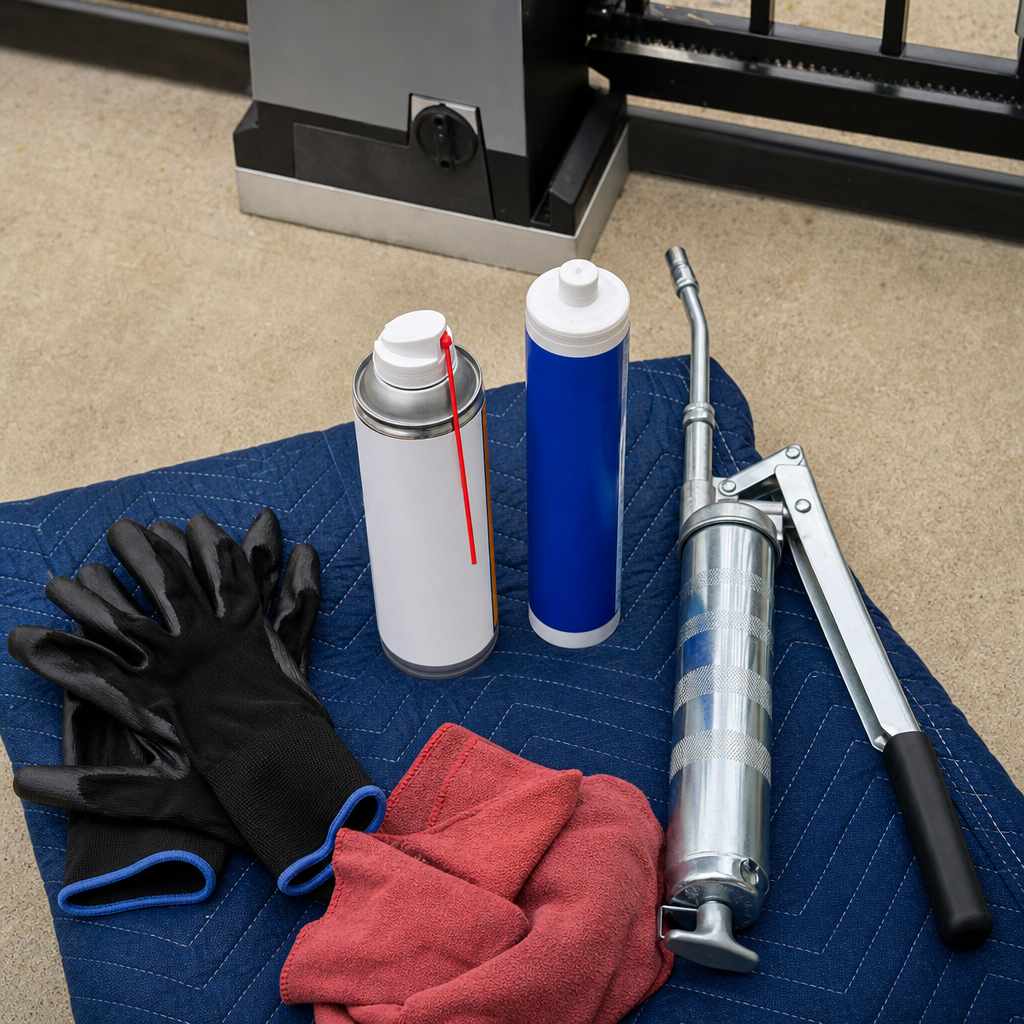
A few basic items make the process straightforward: a grease gun, clean shop rags, safety glasses, a small brush or pick, and a mild, non-corrosive degreaser. Preparing these items beforehand ensures a clean workspace and helps minimize unnecessary mechanical resistance on the gate system.
Step 1: Disconnect Gate Opener Power for Safety
Need how to lubricate automatic gate hinges?
We’re available now — call for a fast, free estimate.
Before servicing moving gate hardware, disconnect power to the operator and release the drive mechanism. Working on hardware while the opener remains energized introduces potential pinch risks if an access control device, remote button, or auto-close timer activates the motor unexpectedly.
- Cut electrical power: Switch off the dedicated circuit breaker in your electrical panel, or switch off the main power switch inside the operator enclosure.
- Disengage the drive arm: Use the manufacturer manual release key or disconnect pin to uncouple the drive mechanism from the gate leaf.
Once power is off and the drive mechanism is disengaged, swing the gate leaf open and closed by hand. This allows you to evaluate the movement of the panel and identify potential binding or resistance.
Step 2: Clean Off Old Grime, Road Dust, and Degraded Grease
Before applying fresh grease to any hinge, wipe away loose dirt and dried debris. Applying new grease over a dirty fitting can carry surface grit into the hinge assembly, which may accelerate wear on internal pins and bearings.
- Wipe exterior metal: Use a dry shop rag to remove loose dust, cobwebs, and road film from hinge barrels and mounting plates.
- Dissolve stubborn residue: Apply a mild degreaser around joint gaps and clean off residue with a stiff nylon or brass brush.
- Clear grease ports: Clear dried mud and dirt from the tip of each Zerk nipple using a small pick or cloth so that only clean lubricant enters the fitting.
Step 3: Inspect Hinges for Sagging, Rust, and Wear
Examine hinge brackets and mounting welds before adding fresh lubricant. While lubrication helps reduce metal-on-metal friction, it does not correct physical sagging, leaning posts, or cracked structural elements.
- Check for metal shavings: Look around hinge seams for dark metal dust or misshapen pin openings, which can suggest internal wear.
- Examine mounting welds: Inspect the weld joints connecting hinge plates to the post and gate frame for visible cracks or compromised paint lines.
- Check post alignment: Ensure the hinge post remains stable and that the bottom edge of the gate moves clear of the driveway surface.
Lubricant cannot correct structural misalignment or a sagging frame. Forcing an unlevel gate to cycle can place added strain on the operator. If you discover compromised welds or post shifting, Total Gate Repair Care provides on-site mobile welding and realignment services to help stabilize the assembly.
Step 4: Apply Lubricant via Zerk Fittings or Hinge Seams
Depending on the hinge design, apply grease through existing fittings or apply a targeted spray into seam gaps on non-greasable hinges. Adding fresh grease through a fitting helps flush out older residue and maintain coverage on the internal pin.
Grease Gun Method for Hinges with Zerk Fittings
Using a grease gun allows controlled lubricant application for heavy swing hinges equipped with fittings.
- Push the grease gun coupler onto the clean Zerk fitting until firmly seated.
- Pump two to three steady strokes of suitable grease into the fitting, stopping if you see clean lubricant emerge from the hinge seam.
- Wipe away expelled grease with a clean cloth to prevent dust buildup.
Aerosol Lubricant Method for Sealed or Non-Zerk Hinges
If your gate is built with sealed barrel hinges lacking fittings, use a white lithium spray or silicone lubricant with an extension straw.
- Position the extension straw at the upper and lower seams of the hinge barrel.
- Apply short, targeted sprays into the seam gaps, allowing the fluid time to penetrate between the pin and barrel.
- Wipe away any excess run-off to keep posts and hardware clean.
Step 5: Manually Swing the Gate to Distribute Lubricant
Need how to lubricate automatic gate hinges?
We’re available now — call for a fast, free estimate.
After applying lubricant, move the gate through its full swing arc four or five times by hand. Manual movement helps distribute the lubricant evenly across the pivot surfaces.
- Cycle the full arc: Move the gate steadily from fully open to fully closed to check for smooth travel without motor assistance.
- Listen for noise: Note how the gate operates, checking for significant grinding or irregular resistance.
- Wipe away excess grease: Clean up any extra lubricant pushed out around the seams during manual cycling.
Step 6: Reconnect Power and Test Automatic Gate Operation
Complete the process by reconnecting the drive mechanism, restoring power, and testing gate operation with your control device. This confirms that the leaf moves smoothly without unexpected hesitation or obstruction triggers.
- Re-engage the drive arm: Reinstall the manual disconnect pin or lock the clutch mechanism back into automatic operation per manufacturer instructions.
- Restore power: Turn the circuit breaker or control board switch back on.
- Run test cycles: Use your remote or keypad to run the gate through complete open and close cycles.
Observe the gate while it operates. Properly lubricated hinges help support smooth motion, reducing unnecessary mechanical resistance on the gate operator.
When to Call a Professional Gate Repair Service
Reach out to a qualified gate technician if the gate drags, shows bent hinge plates, or remains stiff after basic servicing. If internal hinge components or mounting welds are damaged, operating the automated system can increase mechanical stress on the drive system.
Signs of Structural Wear vs. Dry Hinges
Lubricant alone cannot resolve structural fatigue. While proper greasing helps quiet dry hardware, conditions like leaning posts, bent pins, or fractured welds require physical repair. Operating a system with structural damage can lead to premature wear across mechanical components.
Professional Repair Options
Professional technicians can evaluate alignment, perform mobile welding, and replace hinges according to manufacturer specifications. If basic maintenance uncovers structural issues or heavy resistance, Total Gate Repair Care can assist. We provide upfront pricing and dispatch across Santa Paula to help resolve hardware concerns before they contribute to broader equipment wear.
Frequently Asked Questions About Gate Hinge Lubrication
Routine hinge care supports steady operation and reliable access. Below are answers to common questions regarding lubricants, schedules, and repair considerations.
Can I use regular WD-40 on electric gate hinges?
Standard WD-40 is primarily a solvent-based water-displacement spray rather than a long-term mechanical lubricant. It can wash away existing grease and leave a light film that attracts dust. For durable lubrication, refer to your manufacturer manual, which generally suggests heavier synthetic or marine-grade greases for fittings and lithium or silicone sprays for sealed seams.[4]
How often should automatic driveway gate hinges be lubricated?
Many residential swing gate hinges are serviced roughly every six months, while higher-traffic applications may be checked every three to four months. However, maintenance intervals vary by gate model, environment, and manufacturer guidance. Always consult your product manual for the specific schedule recommended for your equipment.
How much does professional hinge repair cost, and how fast is service in Santa Paula?
Professional hinge realignment or replacement costs depend on whether welding, post adjustments, or hardware replacements are needed. Total Gate Repair Care provides clear estimates before starting work. For property owners in Santa Paula, our team offers prompt service to address hardware issues effectively and safely.
Need how to lubricate automatic gate hinges?
We’re available now — call for a fast, free estimate.
Sources
- Automatic Gate Opener Maintenance – Handyman tips – handymantips.org
- Dr. Nancy McGuire Selecting lubricating greases: What you … – stle.org
- Automatic gate maintenance: tips to make gates last longer – CAME – came.com
- 7 Common Gate Maintenance Mistakes Homeowners Make – journeymanhq.com
Related reading: Residential Access Control System – Call Now-10% Off – Same-Day Service – Free Estimate
Related reading: Gate Maintenance Packages Santa Paula – Call Now-10% Off – Same-Day Service – Free Estimate
Related reading: Residential Door Access Control – Call Now-10% Off – Same-Day Service – Free Estimate
Frequently Asked Questions
What should I do if grease will not enter the hinge Zerk fitting?
If grease will not enter the fitting, the internal check-ball is likely jammed with hardened residue or road dirt. Clean the fitting tip with a small wire pick or replace the Zerk nipple before applying pressure with the grease gun. If fresh grease still cannot penetrate, contact Total Gate Repair Care to check for internal pin galling or seized components.
How can I tell if a noisy gate hinge is simply dry or structurally damaged?
A dry hinge emits a light squeak that disappears once lubricant is evenly distributed across the pivot surfaces. If the hinge produces a heavy grinding noise, drops dark metal shavings, or allows the gate frame to sag, the internal pin or bearing has failed. When fresh grease does not eliminate friction, Total Gate Repair Care can evaluate whether hinge rebuilding or mobile welding is required.
Can neglected gate hinges cause the automatic opener motor to burn out?
Yes, unlubricated hinges dramatically increase mechanical resistance during open and close cycles, forcing the operator to draw excess electrical current. Over time, this continuous physical strain can strip internal drive gears, blow control board components, or trigger false obstruction reversals. Keeping hinge pins greased preserves motor life by ensuring effortless panel movement.
About the author
 |
Marcus Vance Marcus Vance is a seasoned security systems specialist with over 12 years of experience in the access control industry. Holding a degree in Electrical Engineering from California State Polytechnic University, Pomona, he focuses on the practical application of gate motor diagnostics and commercial access solutions. His writing aims to provide actionable maintenance advice for property owners and facility managers. |