
Quick Summary
Commercial gate access systems benefits extend beyond physical perimeter security to streamline vehicle pacing, reduce rekeying expenses, and provide auditable digital entry tracking. Total Gate Repair Care helps property managers maximize site safety and operational efficiency by delivering expert consultation, certified installation, and 24/7 maintenance for modern solutions like long-range RFID and mobile credentials. Readers will understand how to select appropriate credential hardware and can schedule a professional on-site assessment to ensure code-compliant, durable gate automation.
Commercial Gate Access Systems Benefits: Boost Site Safety
The practical commercial gate access systems benefits go beyond mounting a physical barrier across a driveway. An automated entry setup secures property boundaries, controls vehicle entry, and helps reduce the continuous expense of physical rekeying when staff changes occur. In general practice, access control systems can also assist in regulating vehicle pacing at entry points, though specific mechanical impacts depend on the gate operator and installation design.
Commercial gate operators are electro-mechanical systems. According to specialists at Total Gate Repair Care, when properly integrated with compatible credentials and vehicle detection accessories, they help protect perimeters while supporting controlled facility traffic flow.
What Are the Primary Commercial Gate Access Systems Benefits?
What are the primary commercial gate access systems benefits in brief? Commercial gate access systems deliver authenticated entry based on predefined permissions, ensuring controlled access to physical areas and assets. Key benefits include streamlined credential administration, support for organizational compliance, improved operational efficiency, user convenience, reliability, and auditability where event logging is supported.
Installing an automated entry setup establishes a controlled checkpoint. Instead of leaving a driveway open or depending exclusively on manual padlocks, organizations can manage entry based on authorized rules while supporting predictable traffic movement.
Immediate Perimeter Defense and Vehicle Tracking
Securing commercial properties with automated gates allows facilities to replace manual padlocks or unmanaged access with digital credentials. Access controllers authenticate drivers or vehicles against assigned permissions before triggering entry. Where logging features are enabled, systems can record entry activity, providing administrative visibility into site access.
Streamlined Operational Efficiency and Reduced Overhead
Automating entry verification reduces the need for manual gate operations at every lane. Depending on the system architecture, administrators can update permissions centrally. In the 2025 survey, 42% of access-control end users reported deploying wireless locks, up from 39% in 2023.[2]
Strengthening Commercial Security with Digital Access Control and Audit Logging
Digital gate controls can serve as active data collection points when equipped with logging capabilities. Recording entry events gives facility directors visibility to support site compliance and security evaluations.
Time-Stamped Entry Logs and Compliance Tracking
When configured with logging, commercial gate access control systems can record entry activity for employees, delivery drivers, and outside contractors. Digital credentials can also be modified or revoked in software as staffing changes occur. In 2025, 17% of surveyed organizations reported fully mobile access solutions, compared with 5% in 2023.[3]
Integration with Commercial CCTV and Intrusion Alarms
Perimeter hardware is often deployed alongside secondary security layers, subject to site design and system compatibility (general design considerations requiring specific site engineering):
- Video Integration: Integrating gate controllers with IP cameras can allow systems to correlate video records with credential authentication events.
- Alarm and Tamper Monitoring: Monitored enclosures and gate hardware can be configured to signal alarms or remote monitoring stations if forced entry or tampering occurs.
- Vehicle Safety and Flow Devices: Photo eyes and ground loops are commonly used to detect vehicle presence and help prevent gate movement while vehicles are in the transit path.
How Access Control Systems Regulate Vehicle Entry and Manage Traffic Flow
Need commercial gate access systems benefits?
We’re available now – call for a fast, free estimate.
Access control hardware can assist with vehicle pacing. Without controlled access, unmanaged traffic queues can cause congestion and frequent start-stop cycling for gate operators.
Managing Traffic Bursts and Vehicle Queues
During peak shift changes or delivery periods, automated credential verification helps maintain structured entry flow. A 2025 survey found that 91% of respondents viewed mobile access and authentication technology as useful.[4]
Mitigating Environmental and Mechanical Stress
In regions subject to wet seasons or shifting soil, ground movement can affect gate alignment and place extra strain on mechanical components. As highlighted by Total Gate Repair Care, while soft-start and soft-stop motor profiles can reduce mechanical shock on hinges and drive assemblies, physical site drainage, proper footings, and regular mechanical maintenance remain necessary general engineering considerations.
Comparing Commercial Gate Credential Technologies: Keycards, RFID, and Mobile Entry
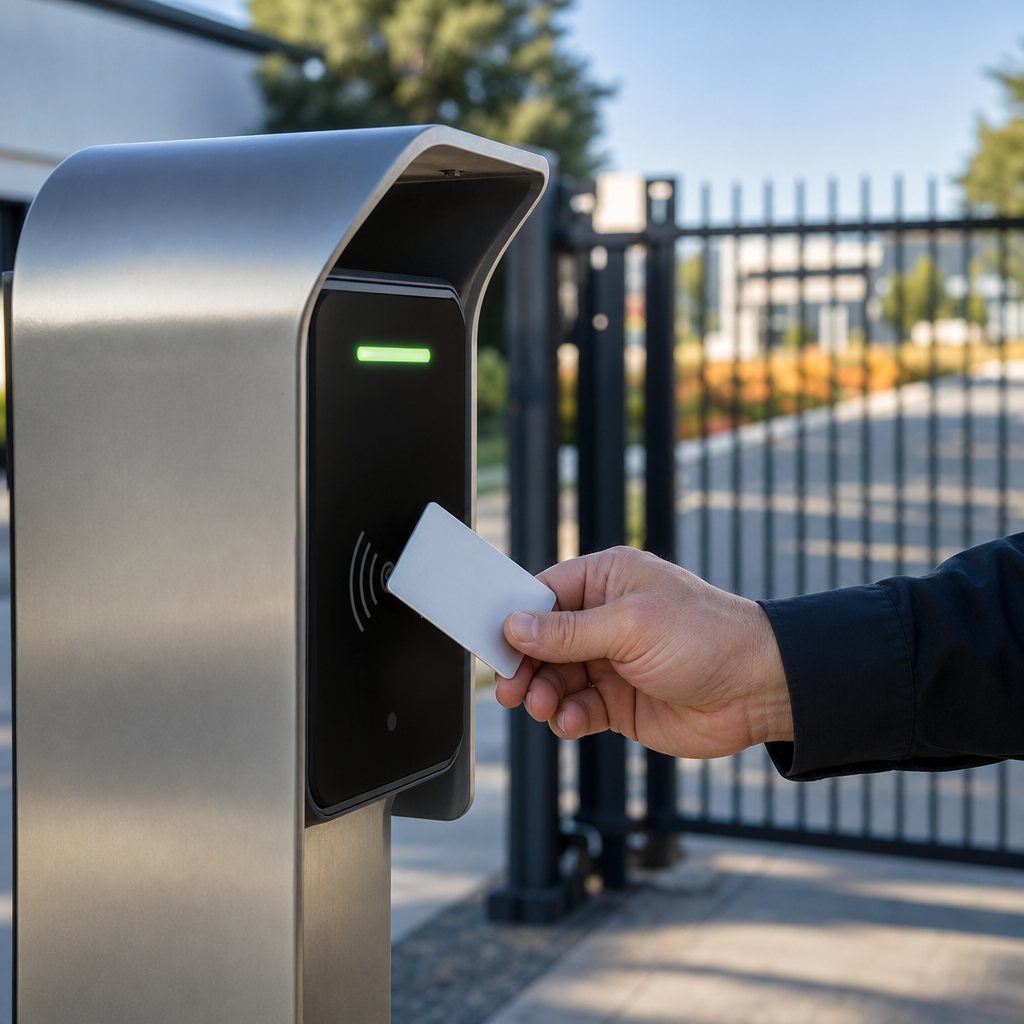
Selecting an appropriate credential format affects vehicle throughput and administrative flexibility. Traditional cards generally require drivers to stop at a pedestal, whereas long-range RFID and mobile credentials allow reading from a distance.
| Feature | Long-Range RFID | Mobile BLE / Cloud | Keycards / Fobs |
|---|---|---|---|
| Credential Format | Windshield tag or rearview mirror decal | Smartphone app or digital wallet pass | Physical proximity card or key fob |
| User Interaction | Hands-free reading through windshield | Hands-free tap or app presentation | Manual swipe or tap at driver pedestal |
| Visitor Flexibility | Common for permanent or fleet vehicles | Adaptable for temporary digital passes | Requires physical card distribution |
Long-Range RFID vs. Smartphone BLE Credentials
Windshield RFID tags are frequently used in commercial fleets and high-volume facilities because they authenticate vehicles without requiring drivers to roll down windows. Mobile Bluetooth Low Energy (BLE) systems offer administrative convenience where credentials need to be issued or revoked remotely. In the same survey, 55% of respondents recognized that access control can support organizational compliance.[1]
Keypads and Intercom Systems for Visitor Verification
Unscheduled deliveries and guest vehicles often require secondary communication tools. Telephone entry and video intercom units allow personnel to communicate with visitors before granting entry, keeping general access lanes clear.
Managing Entry Traffic and Optimizing Security Staffing
Automating access points allows organizations to reallocate staff resources from manual gatekeeping toward broader site management and surveillance duties.
Automated Vehicle Identification (AVI) Case Examples
Documented implementations demonstrate measurable performance gains across various facility types:
- University of Arizona: The RFID-based system nearly tripled vehicle throughput, significantly reduced congestion and fraudulent tag use, and improved safety.
- LSU Health Sciences Center: The facility cleared cars four times faster at the end of the day than with the previous swipe-card system and handled approximately 1,200 vehicles daily.
- University of Georgia: Processing time fell from 15 seconds to 4 seconds, peak-hour throughput rose by more than 77%, egress time fell by 10 minutes, and estimated annual savings included 34,710 gallons of gasoline and a 763,620-pound reduction in carbon monoxide emissions.
- Rede Bandeirantes: Authorization time fell from 3 minutes to 30 seconds, an 84% reduction, with reported annual savings of US$180,000.
Evaluating Operational Efficiency and Security Staffing
The 2025 survey identified improving operational efficiency and reducing costs as the top priority for 56% of respondents. Across sectors including government, public services, manufacturing, retail, critical infrastructure, data centers, logistics, and hospitality, access technology is adopted to improve convenience, compliance, reliability, sustainability, and operational speed alongside core physical protection.[5]
Commercial Gate Access System Costs, Timelines, and Environmental Factors
Need commercial gate access systems benefits?
We’re available now – call for a fast, free estimate.
Project scopes and budgets vary widely depending on whether work involves adding a simple reader to an existing operator or executing a multi-lane installation with dedicated civil trenching, loop detection, and networked controllers.
Factors Influencing Hardware and Installation Investment
Key cost factors generally include power availability, communication trenching distances, credential reader types, and safety accessories. Specific electrical and structural requirements must be evaluated against manufacturer specifications and site conditions.
Addressing Rain, Runoff, and Soil Shift on Commercial Operators
Soil saturation and ground subsidence can cause support posts to shift, leading to binding along gate tracks and increased motor load. General site practices to mitigate these risks include engineered concrete footings, weather-rated enclosures, and adequate drainage around ground-mounted enclosures.
How to Choose a Qualified Commercial Access Gate Specialist
Commercial gate installations involve high-voltage power, mechanical drive systems, and compliance with industry safety standards (such as UL 325 and ASTM F2200). Proper installation requires technical qualification to ensure reliable operation and safety compliance.
Verifying Technical Knowledge and Safety Compliance
Qualified technicians assess operational duty cycles, wire monitored safety devices such as photo eyes, and calibrate entrapment protection sensors so gates respond appropriately to obstructions.
The Importance of Professional Service and Compatible Parts Inventory
Unplanned gate downtime can compromise site security and disrupt daily operations. Working with service providers like Total Gate Repair Care who maintain access to compatible replacement parts and manufacturer-approved components supports ongoing reliability and faster resolution of hardware faults.
Frequently Asked Questions About Commercial Gate Access Systems
Below are general considerations regarding commercial gate automation, emergency operation, and retrofitting.
How quickly can commercial gate service be dispatched during an operational failure?
Service response windows depend on local provider availability and service level agreements. Contracted emergency response times should be confirmed directly with local service providers.
What happens to automated access gates during a power outage?
Many commercial gate operators can be equipped with optional battery backup systems to maintain operation during power outages. Depending on system configuration and life-safety requirements, gates may be set to fail-safe (open) or fail-secure (locked), or operated via manual mechanical releases where equipped.
Are commercial gate systems compliant with local fire and emergency access codes?
Commercial installations must conform to applicable municipal codes and safety standards. Emergency access options, such as key lock boxes, strobe sensors, or radio receivers for first responders, are determined by local jurisdiction requirements.
Can an existing manual or basic automated gate be upgraded with modern access control?
Retrofitting modern access hardware onto an existing gate is often feasible if the structural frame, hinges, tracks, and posts are sound and operate without binding. A professional site assessment is necessary to confirm structural and electrical compatibility.
Need commercial gate access systems benefits?
We’re available now – call for a fast, free estimate.
Sources
- WorldCat Dissertations and Theses | USC Libraries – libraries.usc.edu
- Wireless Access Control Keypad Guide for Gates and Doors – nimbio.com (2034)
- 6th biennial edition – assaabloy.com (2025)
- www.assaabloy.com · wireless-access-control-report-2025Wireless Access Control Report 2025 – ASSA ABLOY – assaabloy.com (2025)
- www.ashb.com · wp-content · uploads2025 Smart Building Trends & Technology Adoption – ashb.com – ashb.com (2025)
Related reading: Home Door Access Control Systems | Call Now-10% Off | Same-Day Service | Free Estimate
Related reading: Door Access Control System for Home – Call Now-10% Off – Same-Day Service – Free Estimate
Related reading: Residential Automatic Bollards | Call Now-10% Off | Same-Day Service | Free Estimate
Frequently Asked Questions
How do I determine if my existing commercial gate can be retrofitted with modern RFID or mobile credentials?
A certified technician must evaluate your gate frame, hinges, alignment, and motor operator to verify they can support modern electrical and cycling demands without binding. Total Gate Repair Care offers comprehensive on-site assessments to identify compatibility and seamlessly integrate advanced readers onto your existing infrastructure.
What routine maintenance is required to prevent commercial gate access system failures?
Commercial systems require regular calibration of entrapment sensors, lubrication of mechanical drive components, battery backup testing, and post-alignment checks for soil shifting. Total Gate Repair Care delivers preventative maintenance programs and 24/7 rapid emergency repair to keep access systems code-compliant and operational.
How do commercial access systems accommodate unscheduled delivery drivers and temporary visitors?
Facilities typically pair long-range RFID or mobile credentials for permanent staff with video intercoms, cloud keypads, or telephone entry units for guest verification. Total Gate Repair Care designs customized multi-credential configurations that let administrators verify visitors remotely and grant single-use or timed gate access.
About the author
 |
Marcus Vance Marcus Vance is a seasoned security systems specialist with over 12 years of experience in the access control industry. Holding a degree in Electrical Engineering from California State Polytechnic University, Pomona, he focuses on the practical application of gate motor diagnostics and commercial access solutions. His writing aims to provide actionable maintenance advice for property owners and facility managers. |