
Quick Summary
Choosing a residential gate intercom requires evaluating driveway distance, wiring infrastructure, power failover, and operator compatibility to ensure dependable perimeter security. Access control specialists like Total Gate Repair Care recommend prioritizing weather-sealed IP65 hardware, stable connectivity via wired lines or cellular networks, and dry-contact relay integration over consumer-grade gadgets. Homeowners will understand how to assess their property layout, balance video and audio features against total installation costs, and select the ideal system with professional guidance.
How to Choose Residential Gate Intercom for Better Security
Learning how to choose residential gate intercom equipment comes down to practical site requirements, wiring, and reliability. With North America standing as the largest regional market for gate intercoms in 2025, picking the right unit is less about flashy features and more about whether the hardware will work reliably during everyday use, storms, or power outages.[2]
After years of fixing gate automation setups, we regularly see the same mistake: homeowners buying sleek consumer gadgets that drop signal halfway down the driveway or short out after the first heavy winter rain. Proper installation with compatible gate operators like LiftMaster, Linear, or DoorKing, as recommended by Total Gate Repair Care, requires understanding low-voltage wiring, signal attenuation, and weatherproofing.
Quick Summary: How to Choose a Residential Gate Intercom
Quick Summary: To pick the right intercom, focus on key buying factors such as video verification, remote monitoring, wiring type, and smart-home integration. Matching your wiring setup and system design to your property ensures reliable performance, while IP65-rated enclosures protect electronics against moisture. Always ensure the unit matches your gate operator’s relay specifications.[4]
Key Factors at a Glance
- Wiring Type and Transmission: Driveway length and infrastructure determine whether you need physical wire, a long-range wireless bridge, or a cellular connection to avoid communication drops.
- Video Verification and Audio: Visual confirmation and two-way voice allow positive identification of visitors before opening the gate.
- Remote Monitoring and Smart Integration: Connected systems enable remote management and integration with broader smart-home access control setups.
- Environmental Rating and Power: Sealed enclosures and battery backups ensure continuous operation during severe weather and utility outages.
What You Will Need Before Selecting a System
Before buying hardware, take a close look at your gate’s physical layout and electrical setup. Gathering accurate site details upfront prevents expensive wiring rework and signal dead zones.
Property and Infrastructure Checklist
- Driveway Distance and Obstacles: Measure the true linear distance from your home router to the gate post. Note line-of-sight obstacles such as stone pillars, dense oak trees, or rising terrain.
- Gate Opener Make and Model: Check your operator control board to verify voltage outputs and relay input terminals.
- Available Power: Determine if you have 110V AC power at the gate, existing low-voltage lines (12V/24V DC), or if you need a dedicated solar panel and battery setup.
- Signal Strength at the Post: Take your smartphone to the exact spot where the intercom will mount and check your Wi-Fi signal (in dBm) and cellular carrier bars.
Step 1: Assess Your Driveway Distance and Signal Transmission
Need how to choose residential gate intercom?
We’re available now — call for a fast, free estimate.
Driveway length is a critical factor when deciding between intercom models. Wireless signals degrade quickly over distance, and physical barriers like concrete pillars or steel gate frames create significant interference.
Handling Real-World Signal Drop
When comparing home gate intercoms, practical range is often much lower than what manufacturer packaging advertises:[5]
- Short Driveways (Under 100 Feet): Standard Wi-Fi units can work well if you have a clear line of sight. However, exterior stucco walls, metal security gates, and double-pane windows reduce signal strength considerably.
- Medium Driveways (100 to 300 Feet): Consumer Wi-Fi intercoms often struggle here, leading to delayed notifications or dropped video calls. A point-to-point wireless bridge with directional antennas is usually necessary to maintain a stable link.
- Long Driveways (Over 300 Feet): For expansive properties, skip standard wireless units entirely. Use direct-burial Cat6 cable, fiber optic lines, or a dedicated cellular intercom.
Step 2: Compare System Types: Audio vs Video, Wired vs Wireless, and Smart Access Control
Evaluating gate intercoms requires comparing audio-only vs video systems, wired vs wireless configurations, and smart-home-integrated access control options to match your property’s layout and security needs.[1]
| Feature | Hardwired (Cat6/Fiber) | Cellular (4G/5G) | Wi-Fi / RF Wireless |
|---|---|---|---|
| Trenching Required | Yes | No | No |
| Effective Range | 1,000+ feet | Depends on cell service and system design | Limited by line of sight and obstacles |
| Monthly Subscription | None | Yes (SIM data plan) | None |
| Interference Resistance | Highest | High | Low to Moderate |
Wired systems offer permanent reliability without recurring subscription costs, making them ideal when a conduit already exists. Wireless and cellular options avoid trenching costs, though cellular units require active network coverage and ongoing data plans. Audio-only systems provide simple voice communication, whereas video models add visual verification for enhanced security.
Step 3: Evaluate Video Verification, Night Vision, and Two-Way Audio
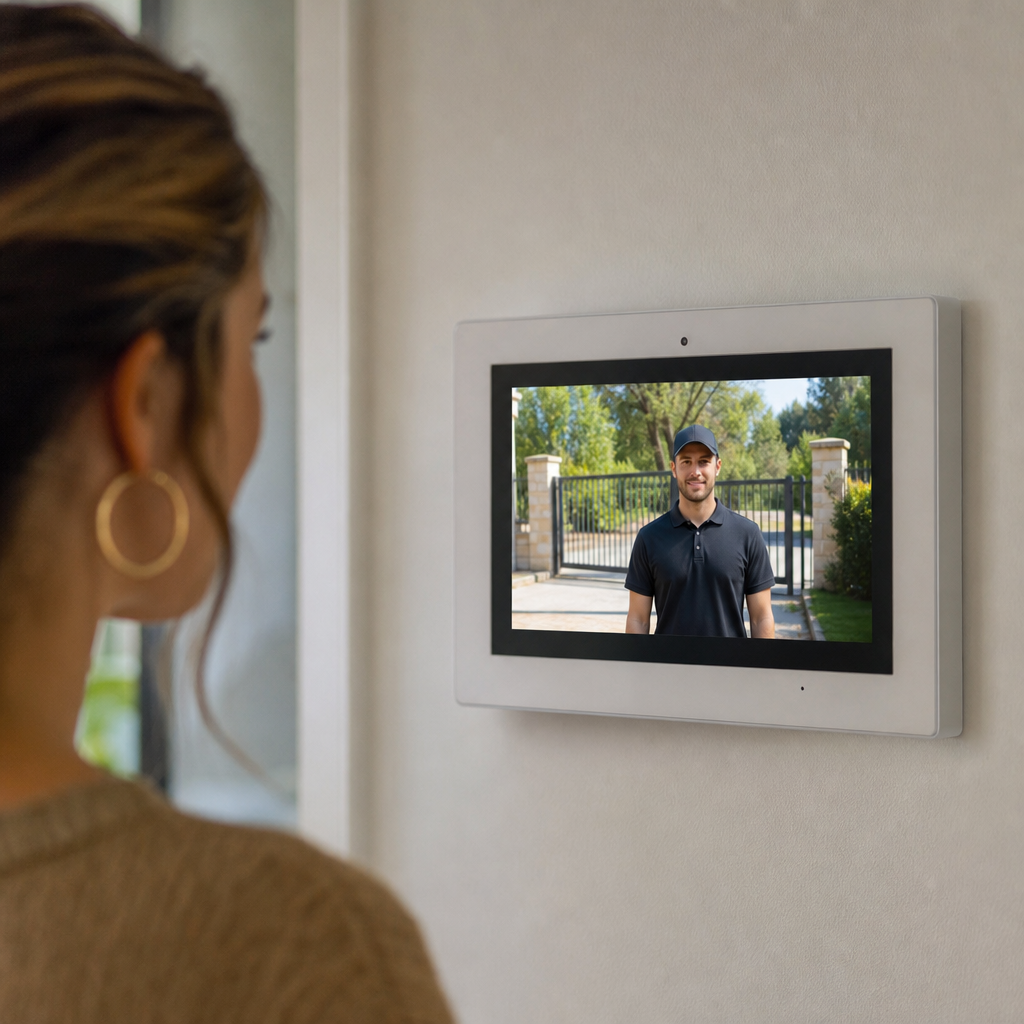
Audio-only buzzers leave you guessing about who is at the gate. Modern video systems provide visual confirmation and remote monitoring of visitors, service contractors, and delivery drivers before you grant access.
Key Camera and Sound Specifications
- 1080p HD Resolution with Wide Dynamic Range (WDR): Direct sunlight can wash out video feeds, while shadows from trees make faces dark. WDR balances bright daylight and deep shadows so visitor faces remain clear.
- Infrared (IR) Night Vision: High-output IR LEDs illuminate visitors in pitch darkness without requiring bright floodlights running all night.
- Full-Duplex Audio with Noise Cancellation: Street traffic, wind, and idling delivery trucks make communication difficult. Full-duplex audio with background noise filtering lets both parties speak naturally without cutouts.
Step 4: Check Power Supply, Battery Failover, and Solar Compatibility
A gate intercom is only as reliable as its power source. During storms or local utility outages, you need confidence that the system will still let you in and out of your property.
Power Options to Prevent Lockouts
- Gate Operator Auxiliary Power: Many intercoms can draw 12V or 24V DC directly from the gate opener board. Make sure the total amp draw of your intercom, keypad, and accessories does not exceed the board’s rated capacity.
- Dedicated Transformer with Battery Backup: Powering the intercom through a separate low-voltage power supply with an integrated sealed lead-acid or lithium backup battery keeps your cameras and entry keypads running when the main power drops out.
- Solar-Charged Battery Banks: Remote gates without utility power require a 20W to 30W solar panel paired with a deep-cycle AGM battery. Ensure the solar setup generates enough surplus current during short winter days to handle continuous standby draw.
Step 5: Verify Gate Opener Integration and Smart-Home Access Control Options
Need how to choose residential gate intercom?
We’re available now — call for a fast, free estimate.
Gate intercoms trigger your operator to open via a basic low-voltage switch, commonly known as a Normally Open (NO) dry contact relay. When a visitor is verified or a valid PIN is entered, the relay briefly closes the circuit, signaling the gate controller to cycle.
Leading gate operators from brands like LiftMaster, DoorKing, Linear, and Viking follow this standard logic. Beyond simple relay triggers, look for entry and smart-home-integrated access control methods that match your needs:[3]
- Backlit Keypads: Essential for night entry without needing a remote control.
- Temporary Guest PINs: Handy for landscapers, pool maintenance, or deliveries, allowing access only during specific hours.
- Smart-Home and App Gate Release: IP-based or app-enabled models may support remote gate release and monitoring, depending on the system.
- RFID Cards or Fobs: A quick tap option that works well for regular visitors and service staff.
Step 6: Account for Weatherproofing and Moisture Protection
Outdoor gate stations face harsh conditions, from blazing afternoon sun to morning fog, heavy downpours, and windblown dust. Moisture accumulation inside unsealed enclosures is one of the most common causes of premature intercom failure, according to Total Gate Repair Care specialists.
Protecting Sensitive Circuit Boards
Look for outdoor stations with a verified IP65 or higher ingress protection rating. Housings made of marine-grade aluminum, powder-coated steel, or UV-stabilized polycarbonate hold up best over time. During installation, technicians should always use waterproof cable glands, run drip loops on wiring runs, and seal conduit openings with silicone or duct seal to stop humid air from venting directly into the back of the keypad housing.
Step 7: Calculate Total Installation Costs and Hire Professional Help
Hardware prices range from basic wireless buzzers to multi-tenant, commercial-grade cellular video stations. Installation costs depend heavily on site conditions:
- Direct Hardware Swaps: Lower labor costs when existing low-voltage wiring and pedestals are reusable.
- Trenching and Conduit: Cutting through asphalt driveways or trenching through rocky soil adds labor and equipment costs.
- Solar and Wireless Bridges: Moderate setup costs that eliminate long-distance excavation.
Because mistakes in low-voltage wiring can easily damage sensitive gate operator circuit boards, working with experienced gate automation specialists like Total Gate Repair Care protects your investment. Technicians can measure voltage drop across long wire runs, test relay triggers safely, and ensure your system is properly grounded against lightning strikes and electrical surges.
Frequently Asked Questions About Residential Gate Intercoms
Frequently Asked Questions: Wired intercoms provide interference-free signals through direct cabling, while wireless units use cellular or Wi-Fi networks to avoid driveway trenching. Cellular intercoms connect to mobile devices based on cell service availability and require a monthly SIM data plan.
Common Questions Answered
What is the difference between wired and wireless gate intercoms?
Wired units rely on physical low-voltage lines (Cat6 or shielded multi-conductor wire) run underground, delivering dependable performance with zero signal interference. Wireless systems use Wi-Fi, radio frequency, or cellular data to communicate, eliminating the need to trench through driveways and landscaping.
Can I connect my residential gate intercom to my smartphone?
IP-based or app-enabled models may support smartphone connectivity depending on the system. When supported, these intercoms link with dedicated iOS and Android apps to let you see live video feeds, speak with guests at the entrance, and trigger the gate release remotely.
Do cellular gate intercom systems require a monthly subscription?
Yes. Cellular intercoms use a standard SIM card (AT&T, Verizon, or T-Mobile) to transmit video and voice over 4G/5G networks. Monthly data plan costs typically range from $10 to $30 depending on whether the system streams live video or voice only.
How far can a wireless driveway gate intercom transmit signal?
Standard Wi-Fi intercoms are generally reliable up to 50 to 100 feet without physical obstructions. Beyond that distance, performance drops quickly. Long-range wireless bridge antennas can extend connectivity up to 1,000 feet with clear line of sight, while cellular intercom range depends on cell service and system design rather than physical driveway distance.
What key features should I look for in an outdoor video gate intercom?
Focus on evidence-backed buying factors including reliable video verification, remote monitoring capabilities, appropriate wiring type for your property, smart-home integration, an IP65 weatherproof rating, and backup power support.
Need how to choose residential gate intercom?
We’re available now — call for a fast, free estimate.
Sources
- Smart Home Access Control Market Size & Share Analysis … – mordorintelligence.com (2030)
- North America Access Control Market Report 2025-2030 [210 Pages & 240 Tables] – marketsandmarkets.com (2030)
- Smart Home Access Control Market Strategic Outlook & Investment Opportunities [2024–2034] – emergenresearch.com (2034)
- Smart Home Access Control – Market Share Analysis, Industry … – marketresearch.com (2029)
- Home Intercom Systems Market Report | Global Forecast From 2025 … – dataintelo.com (2033)
Related reading: Smart Gate Opener Upgrade Cost | 10% Off & Free Estimate | Same-Day Service
Related reading: Best Home Gate Access Control Systems – Call Now-10% Off – Same-Day Service – Free Estimate
Frequently Asked Questions
How do I know if my existing gate opener is compatible with a new smart intercom?
Most major opener brands like LiftMaster, Linear, and DoorKing are compatible with intercoms that use standard Normally Open (NO) dry-contact relays. Total Gate Repair Care advises checking your operator control board to ensure it can supply auxiliary power without exceeding amperage limits or requiring a dedicated external transformer.
Can a residential gate intercom operate reliably on solar power alone?
Yes, remote gate intercoms can run effectively on a 20W to 30W solar panel paired with a deep-cycle AGM battery bank. Total Gate Repair Care recommends calculating your unit's continuous standby power draw to ensure uninterrupted performance during overcast weather and short winter days.
What is the best intercom option for a long driveway if trenching cable is too expensive?
For driveways exceeding 300 feet where trenching is cost-prohibitive, a 4G/5G cellular intercom or a point-to-point wireless bridge provides the most dependable connection. Cellular units eliminate range constraints completely by transmitting video calls over mobile networks without damaging your driveway or landscaping.
About the author
 |
Sarah Miller Sarah Miller is a security and access control specialist with over eight years of experience in the automated gate industry. Holding a degree in Mechanical Engineering Technology from California State Polytechnic University, Pomona, she combines technical knowledge with practical insights. Her writing focuses on residential and commercial gate systems, specializing in emergency repair protocols and preventive maintenance. |