
Quick Summary
Severe runoff can cause soil erosion around driveway gate posts, stripping away lateral earth support and leading to post displacement, structural settling, and gate misalignment. Total Gate Repair Care emphasizes that effective remediation requires diagnosing scour depth and applying targeted solutions, ranging from surface drainage controls to advanced underpinning or deep concrete footing reconstruction. Readers will understand how to assess foundation damage and can schedule a professional post inspection to request a free estimate for comprehensive structural gate repair.
Soil Erosion Driveway Gate Posts: Structural Repairs and Prevention
Heavy rainfall and surface runoff can strip soil away from driveway gate posts. When water removes the lateral earth support around a concrete footing, post movement can impair gate alignment and normal operation. Note that while erosion is a recognized issue, no verified percentage or national count for soil erosion affecting driveway gate posts is provided by the research.[1]
According to specialists like Total Gate Repair Care, addressing erosion around gate posts requires understanding how flowing water affects structural support below the surface, managing runoff, and determining appropriate stabilization methods.
Why Driveway Gate Posts Lean or Sink After Heavy Rain
Flowing surface and subsurface water can remove soil around foundations, leading to foundation scour. Geotechnical research confirms that scour reduces embedment depth, changes soil-foundation stiffness, increases settlement, and significantly reduces the foundation’s load-carrying capacity.[2]
As runoff strips away supporting earth, the footing loses lateral resistance from undisturbed soil. In technical literature, a National Academies guardrail-post study evaluated soil loss depths of 3, 6, 9, and 12 inches and identified a 9-inch soil-loss threshold for considering structural repair on guardrail posts; however, this is a finding specific to guardrail posts and is not a universal driveway gate repair standard.
Professional Opinion: Subsurface Flow and Shallow Collars
In the opinion of some field professionals, pouring oversized, shallow concrete collars on slopes can create subsurface drainage problems. According to this professional view, an oversized shallow concrete block may act as an underground barrier where subsurface water pools against the uphill face, potentially concentrating water flow around and beneath the concrete base (sometimes described as subsurface hydro-shearing) and contributing to void formation. These mechanisms reflect professional contractor opinion rather than verified universal findings.
Post Displacement and Gate Alignment
Post movement can impair gate alignment and operation across automated swing and slide gate systems. When a post shifts, settles, or tilts, the attached gate leaves, tracks, or hardware can fall out of alignment, hindering smooth opening and closing cycles.
Assessing Damage: When Can You Repair vs. Rebuild?
Need soil erosion driveway gate posts?
We’re available now – call for a fast, free estimate.
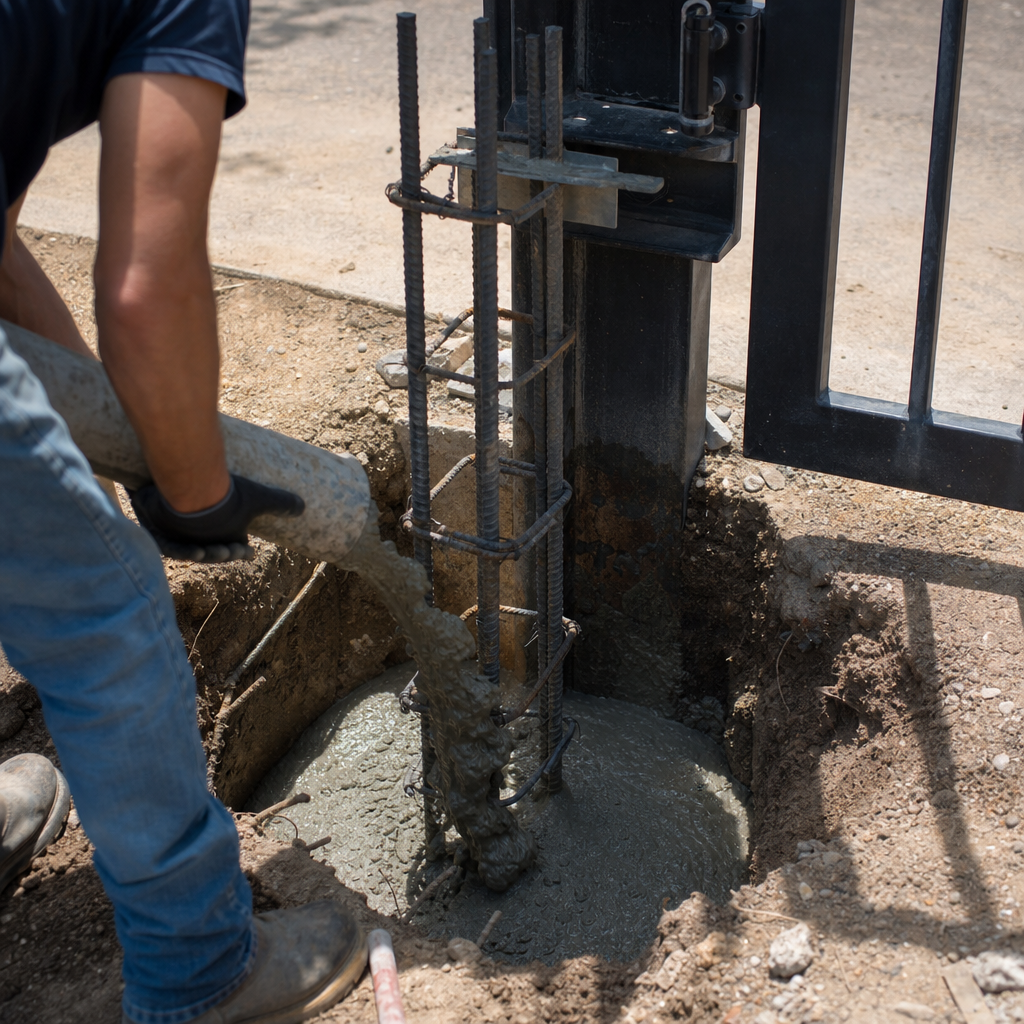
As noted by Total Gate Repair Care, repair guidance depends on the condition of the footing and the extent of soil loss. Limited washout may sometimes be corrected with compacted soil or suitable granular fill and runoff control, while undermined, cracked, badly tilted, or heavily loaded posts may require footing exposure and reconstruction.
| Erosion Extent & Post Condition | Observed Impact | Potential Repair Scope |
|---|---|---|
| Limited surface washout; post is plumb and footing is intact | Minor loss of upper soil support | Compacted soil or suitable granular fill, paired with runoff control |
| Moderate soil loss; minor post movement | Reduced lateral resistance; alignment issues | Evaluation for post realignment and possible project-specific structural stabilization |
| Undermined base, cracked concrete, severe tilt, or heavily loaded post | Significant loss of load-carrying capacity | Footing exposure and full reconstruction based on qualified site evaluation |
Methods to Stabilize Gate Posts in Loose Soil
Addressing gate post stability requires evaluating both the post foundation and site drainage conditions.
1. Foundation Stabilization and Realignment
In specific situations where an existing footing is intact but displaced, structural underpinning, helical pins, hydraulic jacking, and grout injection are possible project-specific measures that may be considered. These methods require qualified engineering or contractor evaluation to determine whether they are appropriate for the specific soil conditions and structural loads.
2. Footing Dimensions and Depth
When full replacement or new construction is necessary, footing dimensions and depth depend on gate loads, soil characteristics, frost depth, slope geometry, site drainage, and the depth required to reach stable undisturbed soil. Deep cylindrical footings or bell footings are potential design options that require site-specific evaluation rather than standardized sizing.
3. Site Drainage and Runoff Management
Managing water flow around gate posts helps prevent recurring soil loss. French drains, trench drains, retaining walls, riprap, and geotextiles are possible project-specific measures requiring qualified evaluation to ensure they fit the local terrain, soil type, and hydraulic demands.
Frequently Asked Questions
How do you stop soil erosion around driveway gate posts?
As recommended by Total Gate Repair Care, runoff control measures, such as properly designed swales, French drains, riprap, or geotextile fabrics, can help divert flowing water away from post foundations. The suitability of these measures depends on site-specific drainage conditions and requires professional evaluation.[4]
Why is my driveway gate post leaning or sinking after heavy rain?
Flowing water can remove supporting soil around the foundation. This scour reduces embedment depth, changes soil-foundation stiffness, increases settlement, and lowers the load-carrying capacity of the footing, allowing the weight of the gate to displace the post.[3]
How deep should gate post footings be to prevent erosion issues on a slope?
There is no fixed universal depth. Footing dimensions and depth depend on gate loads, soil properties, frost depth, slope geometry, drainage conditions, and the depth needed to anchor into stable undisturbed soil.
Can you fix a loose gate post caused by soil washout without digging it up entirely?
Limited washout may sometimes be corrected with compacted soil or suitable granular fill and runoff control. If the post is undermined, cracked, badly tilted, or heavily loaded, it may require footing exposure and reconstruction. Measures such as hydraulic jacking, underpinning, or grout injection are possible options requiring qualified evaluation.
How does soil erosion affect automatic swing and slide gate alignment?
Foundation movement and post displacement can throw swing and slide gate components out of plumb, impairing alignment, hardware engagement, and the overall mechanical operation of the gate system.
Need soil erosion driveway gate posts?
We’re available now – call for a fast, free estimate.
Sources
- [PDF] Improved Calculation of Scour Potential in Cohesive Soils and … – michigan.gov (2014)
- Understanding Soil Risks and Hazards – nrcs.usda.gov
- Effect of Storm Surge-Induced Scour on the Bearing Capacity of Shallow Foundations for Coastal Residential Buildings | Proceedings | Vol , No – ascelibrary.org
- A review of bridge scour monitoring techniques and … – Springer – link.springer.com (2022)
Related reading: Residential Access Control – Call Now-10% Off – Same-Day Service – Free Estimate
Related reading: Gate Hinge Welding Repair Vs Replacement | Call Now-10% Off | On-Site in 60 Minutes | Free Estimate
Related reading: Commercial Gate Access Control Systems Guide | Call Now-10% Off | Same-Day Service | Free Estimate
Frequently Asked Questions
What happens to automatic gate openers if a post shifts due to soil erosion?
Operating an automated swing or slide gate on a displaced post puts severe mechanical stress on opener arms, hinges, and guide rollers, often resulting in motor burnout or track binding. Total Gate Repair Care can realign the gate hardware and stabilize the underlying foundation before expensive drive units suffer irreversible damage.
What structural reinforcement methods work best for driveway gate posts on steep, erosion-prone slopes?
For steep grades, deep cylindrical piers, helical pin anchors, and concrete underpinning help secure the post into stable, undisturbed soil beneath the active washout zone. Total Gate Repair Care pairs these structural footing methods with integrated drainage controls like swales and geotextile wraps to prevent recurrent slope erosion.
How do specialists determine if an eroded gate post needs underpinning or total replacement?
Technicians assess lateral post deflection, scour depth, and concrete footing cracking to calculate whether the existing base has lost its structural load capacity. Homeowners can schedule a professional post inspection with Total Gate Repair Care to receive an engineered evaluation and a free repair estimate tailored to their soil conditions.
About the author
 |
Sarah Miller Sarah Miller is a security and access control specialist with over eight years of experience in the automated gate industry. Holding a degree in Mechanical Engineering Technology from California State Polytechnic University, Pomona, she combines technical knowledge with practical insights. Her writing focuses on residential and commercial gate systems, specializing in emergency repair protocols and preventive maintenance. |