
Quick Summary
Understanding how a magnetic gate lock works is essential for property owners seeking dependable, moving-part-free security for their perimeter access points. As technical experts at Total Gate Repair Care explain, these locks use continuous electrical current to energize an electromagnet against a metal armature plate, generating up to 2,700 pounds of fail-safe holding force. Readers will learn how access-control systems trigger smooth gate releases and why professional maintenance from Total Gate Repair Care is vital to prevent alignment and contact issues.
How Does a Magnetic Gate Lock Work to Secure Gates?
To understand how does a magnetic gate lock work to protect a property, consider the relationship between electricity and magnetism. A magnetic lock uses an energized electromagnet and a metal armature. When electrical current flows through the lock, it creates a magnetic field that draws the metal armature plate against the electromagnet and holds it securely. The lock releases when power is removed or interrupted by access-control logic.[4]
As Total Gate Repair Care explains, because magnetic locks have no moving parts inside the lock body, they do not rely on mechanical latch bolts. When an access-control system interrupts the electrical circuit, the magnetic field drops, allowing the gate to open smoothly.[3] See also Residential Gate Security Solutions – Call Now-10% Off – Same-Day Service – Free Estimate.
How Electromagnetism Keeps a Gate Locked
A magnetic gate lock secures an opening by relying on surface-to-surface magnetic attraction between the electromagnet and the metal armature.
The Electromagnet and Armature Plate
The lock housing contains an internal coil that becomes an energized electromagnet when powered. The matching metal armature plate is mounted directly opposite the magnet on the gate. Magnetic locks are commonly used for access control and are typically paired with release devices such as motion sensors and push-to-exit buttons to allow exit.
Why Holding Force Depends on Surface Contact
Magnetic holding power relies on direct physical contact between the electromagnet and the metal armature plate. If a gap exists between the two components, the strength of the magnetic bond is reduced.
Fail-Safe Operation
Standard electromagnetic locks are fail-safe devices. A fail-safe lock requires continuous electrical power to remain locked. If power is removed or interrupted by access-control logic, the electromagnet de-energizes and the gate releases.[2]
Holding Force Categories
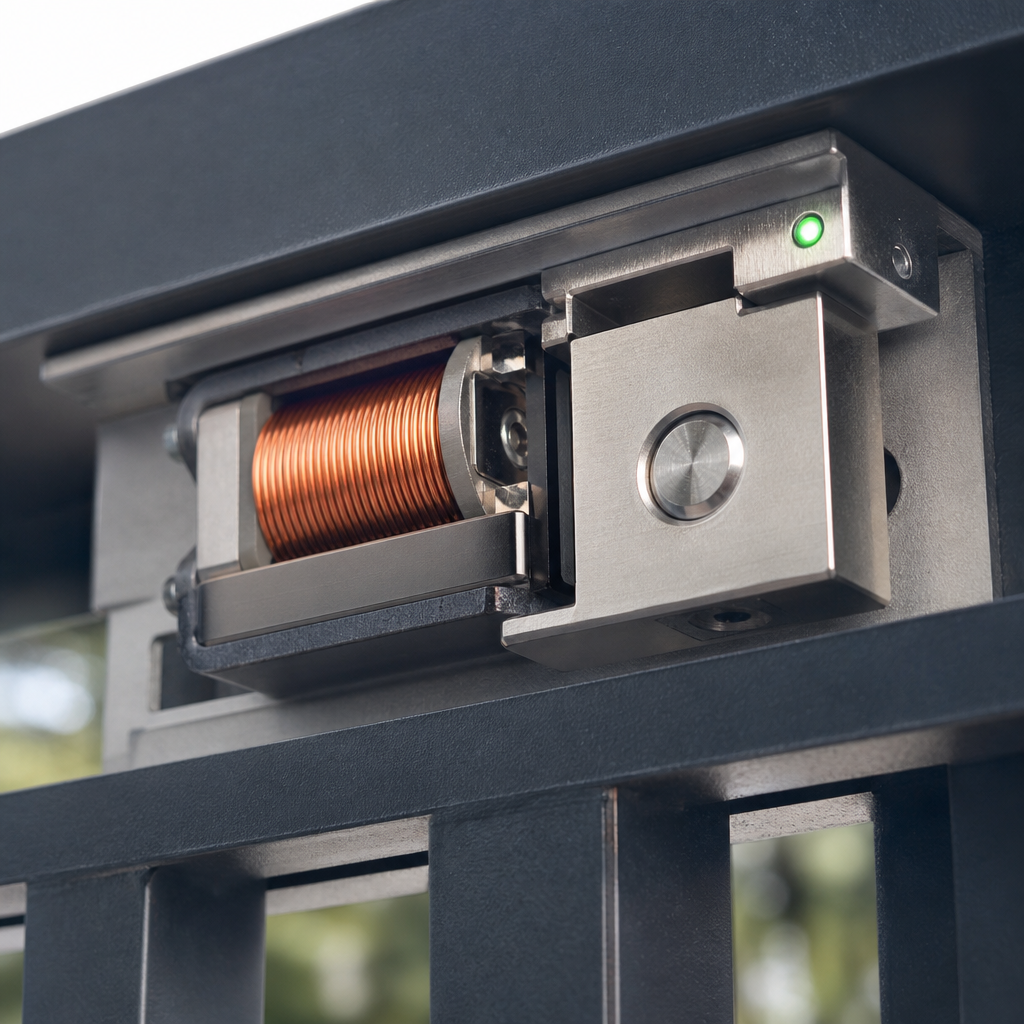
According to Total Gate Repair Care, electromagnetic locks are available in holding-force categories, with common examples including 650 lb, 1200 lb, 1650 lb, 2000 lb, and 2700 lb.[1]
How a Magnetic Lock Integrates with Access Controls
A magnetic lock integrates with access-control systems to manage entry and exit. When release devices such as motion sensors or push-to-exit buttons are activated, the access-control logic interrupts power to the electromagnet, releasing the lock so the gate can open.
Magnetic Gate Lock Maintenance
For an electromagnetic lock to maintain its holding strength, the electromagnet and metal armature plate must make direct, flush contact. Total Gate Repair Care highlights that debris, corrosion, or physical misalignment between the mating surfaces can interfere with contact and weaken the magnetic hold.[5]
Need how does a magnetic gate lock work?
We’re available now – call for a fast, free estimate.
Sources
- [PDF] Public Input No. 1-NFPA 731-2023 [ Section No. 2.3.3 ] – docinfofiles.nfpa.org (2023)
- ANSI/BHMA A156.23-2022 – webstore.ansi.org (2022)
- ANSI/BHMA A156.23-2017 – webstore.ansi.org (2017)
- Electromagnetic Door Locks: Magnetic vs Electric Strikes – avigilon.com
- [PDF] Electromagnetic Locks – Security Door Controls – sdcsecurity.com
Related reading: What Is a Smart Driveway Gate System | 10% Off & Free Estimate | Same-Day Service
Related reading: How to Choose Residential Gate Intercom | Call Now-10% Off | Same-Day Service | Free Estimate
Related reading: Smart Gate Opener Upgrade Cost | 10% Off & Free Estimate | Same-Day Service
Frequently Asked Questions
What happens to a magnetic gate lock during a power outage?
Because standard magnetic gate locks operate as fail-safe devices, they automatically unlock and release the gate whenever electrical power is cut. To keep your property secure during blackouts, Total Gate Repair Care recommends installing a dedicated battery backup system to maintain continuous power to the electromagnet.
How do I choose the right holding force for my gate's magnetic lock?
The ideal holding force depends on your gate's size, weight, wind exposure, and required security level, with options ranging from 650 lbs for light pedestrian gates to 2,700 lbs for heavy vehicular gates. A licensed technician from Total Gate Repair Care can assess your setup to specify the correct lock strength for maximum perimeter security.
Why is my magnetic gate lock losing its holding power?
A decrease in holding force is usually caused by physical misalignment between the electromagnet and armature plate, dirt or rust buildup on the mating surfaces, or low voltage supply. Total Gate Repair Care provides professional troubleshooting and realignments to restore flush surface contact and ensure peak magnetic strength.
About the author
 |
Sarah Miller Sarah Miller is a security and access control specialist with over eight years of experience in the automated gate industry. Holding a degree in Mechanical Engineering Technology from California State Polytechnic University, Pomona, she combines technical knowledge with practical insights. Her writing focuses on residential and commercial gate systems, specializing in emergency repair protocols and preventive maintenance. |